81
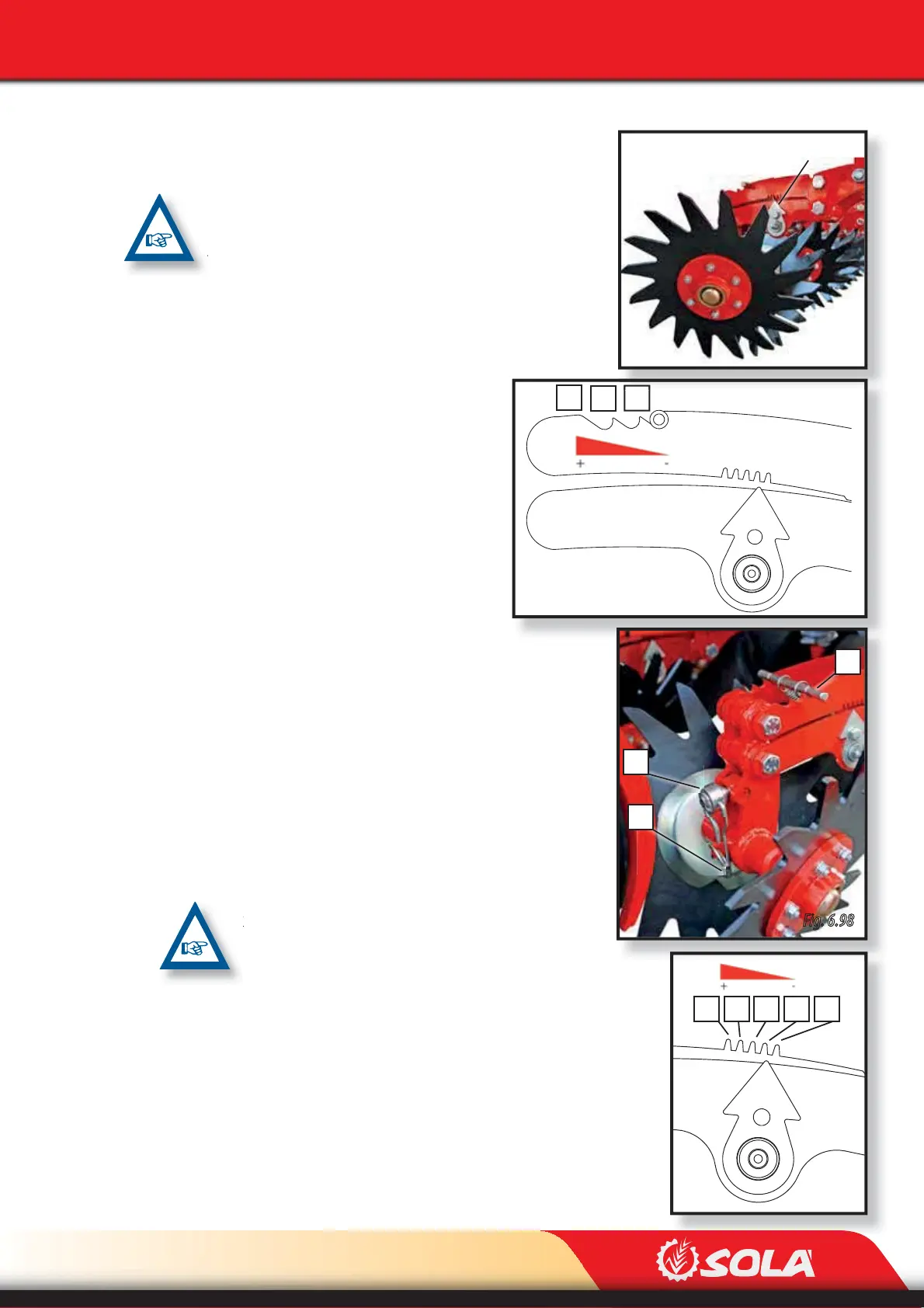
Fig. 6.99
A1A2A3A4
A5
B1B2
B3
Fig. 6.97
1
Fig. 6.98
2
3
ADJUSTMENTS
6.13 FURROW’S RESIDUE ROTARY CLEANERS WITH
PARALLELOGRAM (OPTIONAL)
PERFORM THIS OPERATION WITH THE MACHINE IN A RAISED
POSITION.
The furrow’s residue rotary cleaner pushes aside the residues
present in the sowing row. They need always to work super-
cially pushing the residue aside.
Both the PRESSURE exerted onto the ground and the WOR-
KING DEPTH STOP can be adjusted as follows:
PRESSURE
To adjust the pressure of the furrow’s residue
rotary cleaner, pull the handle (3, Fig. 6.98)
and place it at one of the 3 working positions
(B1, B2 or B3, Fig. 6.97).
WORKING DEPTH STOP
To adjust the working depth stop, follow
these steps:
1- Remove the pin (1, Fig. 6.98) to free the crank (2, Fig.
6.98).
2- Raise the furrow’s residue rotary cleaner using one
hand and use the other hand to turn the crank until
the working depth stop is set at the desired position.
For this purpose, use the depth indicator (3, Fig. 6.98).
3- Once the working depth stop has been set, lower the
crank (2, Fig. 6.98) and place the pin back (1, Fig. 6.98)
to lock the stop.
AFTER ADJUSTING, WORK THE GROUND SOME METRES
TO CHECK THAT THE WORKING DEPTH STOP HAS BEEN
CORRECTLY SET.
In the case of no-till farming on hard ground, it is not
necessary to adjust the working depth stop, since the
furrow’s residue rotary cleaners will adapt to the terrain
without turning the soil. In this case, the working depth
stop needs to be inactive, set at position A5 (Fig. 6.99).
In the case of tilled ground, either adjust the working
depth stop or exclude the furrow’s residue rotary clea-
ners. To exclude them, set the working depth stop at
position A1 (Fig. 6.99).
INDICATOR
Fig. 6.96


 To Next Page