GB.GOLDSKE.160901
12 www.swegon.com
We reserve the right to alter specifications without notice.
3.2 Adjusting the Duct System
and Air Terminals
In order to prevent the fans from consuming more power than
necessary, it is important to keep the pressure drop in the system
at the lowest possible level. It is also important that duct systems
and air terminals are correctly commissioned to provide the
comfort expected.
When commissioning air terminals and the duct systems for the
GOLD, it is appropriate to follow the proportionality method.
This means that the ratio between the airflows in branch ducts
remains constant even if you change the airflow in the main
ducts. The same ratio applies to the air terminals in the installa-
tion.
When commissioning the duct system there is provision for
locking the speed of the fans in the air handling unit to provide a
specific preset flow rate, see Section 5.3.1.3.
3.2.1 Adjustment Sequence
The system should be adjusted in the following order:
1. Adjust of the air terminals in each branch duct.
2. Adjust the branch ducts.
3. Adjust the main ducts.
3.2.2 Adjustment Procedure
1. Set all the air terminals and dampers to the fully open posi-
tion.
2. Calculate the quotient between the airflow reading and the
design airflow of all the air terminals, branch ducts and main
ducts. The air terminal in every branch that has the lowest
quotient should be fully open. Use this air terminal as an
INDEX AIR TERMINAL. The same applies to branch dampers
and main dampers.
When you’ve finished commissioning, one air terminal in
every branch, one branch damper and one main damper
should consequently be fully open.
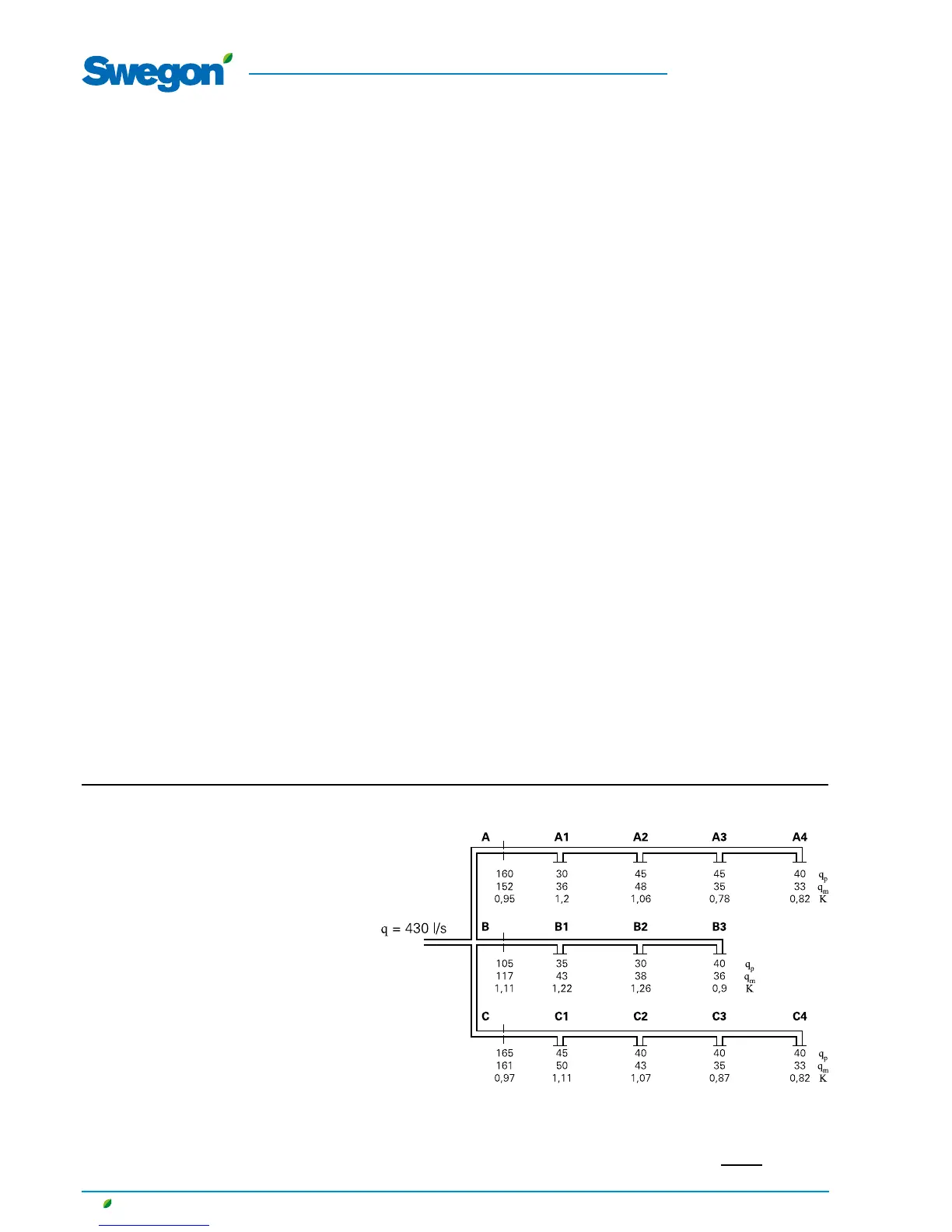
Example on how to make an adjustment
– Start adjusting duct branch B, since this one has the high-
est quotient.
– The last air device, B3, has the lowest quotient and should
be fully open.
Adjust the other air devices, B1 and B2, so that these will
have the same quotientas air device B3 (see item 5 above).
– Now adjust the air devices in branch duct C. Air device
C4 should be fully open; throttle the others to the same
quotient.
– Adjust the air devices in branch duct A. The index air
device here is air device A3, which means that you first
throttle air device A4 (the reference device) to device A3:s
quotient. Then adjust the others to the same quotient as air
device A4.
– Throttle branch damper B to the same quotient as branch
damper A, throttle branch damper C to the same quotient
as branch damper A.
Check that all dampers have the same quotient.
When commissioning has been completed, 3 air devices and
one branch damper should stand fully open to obtain the
lowest possible pressure in the system.
qp = design airflow (l/s)
qm = flow reading (l/s)
qm
K (Quotient) =
qp
3. Start adjusting the main duct that has the highest quotient
and the branch duct in the main duct that has the highest
quotient. Starting from this point enables you to then "press"
the air in front of you toward the sections of the system that
have the least air.
4. Adjust the last air terminal on the duct branch so that it will
have the same quotient as the index air terminal. This air
terminal becomes the REFERENCE AIR TERMINAL. Often it is
the last air device on the branch that has the lowest quotient
and this air terminal should be open. In this case, the index
air terminal and the reference air terminal will be one and the
same.
5. Throttle the other air terminals in the branch to the same
quotient as the reference device.
N.B.! The quotient in the reference terminal will change every
time another air terminal is throttled, so in practice the quo-
tient for the reference air terminal can be set slightly higher.
The reference device must be measured in between each air
terminal throttled.
6. Go to the branch that had the next highest quotient and
adjust the air terminals there, etc.
N.B.! All branch dampers should be fully open until all air
terminals have been adjusted.
7. Throttle the branch damper that had the highest quotient to
the same quotient as the branch that had the lowest quo-
tient.
N.B.! Keep in mind that the index damper changes quotient;
proceed as described in item 5.
8. When all branches have been commissioned, throttle the main
dampers in the same manner.
See also Adjustment example below.





 To Next Page