P401 maximum valueis 1.8 x P295 for model 4.2A/500-600 V and 1.6x P295
for models 7 A and 54 A/220-230 V; 2.9 A and 7 A/500-600 V; 107 A,
147Aand 247A/500-690 V; 100A, 127Aand 340A/660-690 V.
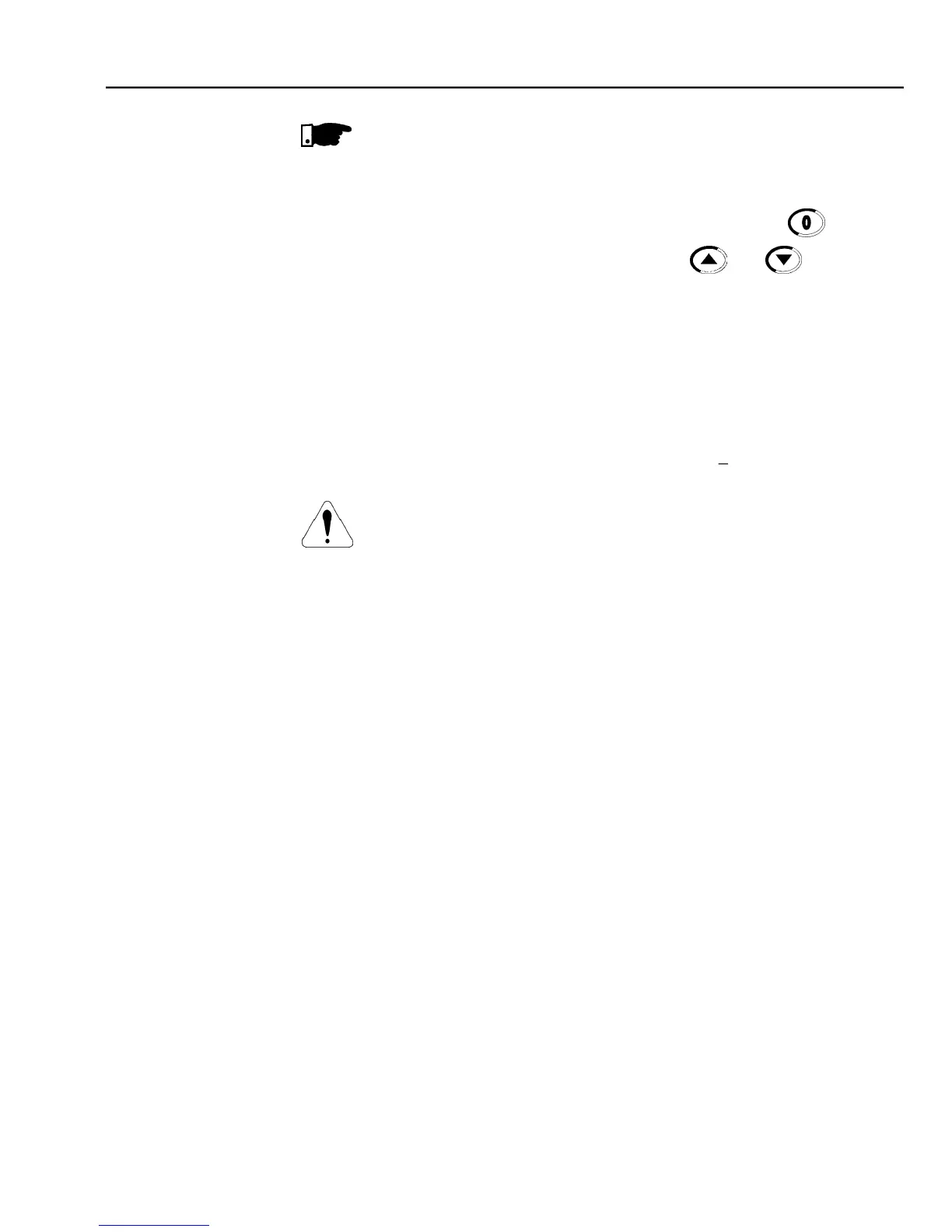
The self-tuning routine can be cancelled by pressing the key.
The last speed reference value set via the and keys is saved.
Ifyou wishto change this value before enabling theinverter,changeparameter
If E01 fault occurs during deceleration, you must increase deceleration time
If the rotation direction of the motor is not correct, switch off the inverter. Wait 10
minutes to allow a complete discharge of the capacitors and swap anytwo wires
at the motor output. If motor is equipped with an encoder, change the phase of
the encoder connections (exchange channelAandA).
In Vector Mode (P202 = 3 or 4), when the command STOP (START/STOP) is
enabled - refer to figure 6.37, the motor will decelerate up to zero speed, but it
maintains the magnetization current (no-load current). This maintains the motor
with rated flux and when the next START command is given, it will achieve a
Forself-ventilatedmotors with no-loadcurrent higher than 1/3 of the rated current
(generally small motors lower than 10 hp), it is recommended that the motor
does not stay in this condition (magnetization current) for a long time, since it
may overheat. In these cases, we recommend to deactivate the command “Ge-
neral Enable” (when the motor has stopped), thus decreasing the motor current
Another waytodisablemagnetization currentwith the motor stoppedis toprogram
P211 to 1 (zero speed disable is ON) for both vector modes and, for vector with
encoder, still another option is to program P181 to 1 (Magnetization mode). If
magnetization current is disabled with the motor stopped, there will be a delayat
start while the flux builds up.
The VVW (Voltage Vector WEG) Control Mode follows the same philosophy of
theV/FControl.TheVVW Control allows a reasonableimprovementofthesteady-
state inverter performance: it results in a better speed regulation and in a higher
torque capability at low speeds (frequencies lower than 5 Hz).
As a result, the frequency (speed) range of the system is increased with respect
to the V/F Control. Other advantages of this control are the simplicityand ease of
The VVW Control uses the stator current measurement, the stator resistance
(thatcan be obtained from theself-tuning routine) and the motor nameplatedata
toautomatically estimate the torque value, the output compensationvoltage value
and, consequently, the slip compensationvalue, which substitute the function of
parameters P137 and P138.


 To Next Page