CHAPTER 6 - DETAILED PARAMETER DESCRIPTION
The function of the PID regulator is activated by setting P203 to 1.
Figure 6.47 shows the block diagram of theAcademic PID regulator.
The transference function in the frequency domain of the Academic PID
Substituting theintegratorbya sum and the derivative bythe incrementalquotient,
wewill obtain an approximate value for the discrete (recursive) transfer equation
Kp (Proportional Gain): Kp = P520 x 4096;
Ki (Integral Gain) : Ki = P521 x 4096 = [Ta/Ti x 4096];
Kd (Differential Gain) : Kd = P522 x 4096 = [Td/Ta x 4096];
Ta = 0.02 s (sampling period of the PID Regulator);
SP*: reference, has 13 bits max. (0 to 8191);
X: process variable (or controlled), read atAI2 orAI3, has 13 bits maximum;
y(kTa): current PID output, has 13 bits maximum;
y(k-1)Ta: previous OPID output;
e(kTa): current error [SP*(k) – X(k)];
e(k-1)Ta: previous error [SP*(k-1) – X(k-1)];
e(k-2)Ta: error of the two previous samplings [SP*(k-2) – X(k-2)].
The feedback signal must be sent to the analog inputsAI2' andAI3' (refer to
When using the PID function P233 must be set to 1, otherwise the minimum
speed (P133) will be added to the PID feedback viaAI2.
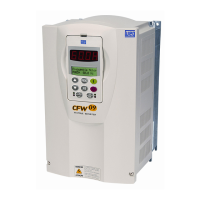
The CFW-09 is fitted with the PID regulator that can be used for closed loop
process control. This function acts as a proportional, integral and derivative
regulator, superimposed on the normal inverter speed control.
The speed will be changed in order to maintain the process variable (the
variable that should be controlled - for instance: water level of a container) at
the desired value, set in the setpoint.
This regulator can control, for example, the flow in a piping system through
the flow feedback to the analog inputAI2 orAI3 (selected via P524), and the
flowreference set atP221 or P222 -AI1, whentheinverter drives the motor of
a pump that circulates the fluid through this piping system.
Other application examples: level control, temperature control,


 To Next Page