Axio Imager 2 OPERATION ZEISS
Illumination and contrast methods
01/2016 430000-7544-001 175
(4) Conclusions
The grayish-white color appearing first in the
bright position in the above example (Fig. 200/1
)
corresponds to a path difference of 150 nm
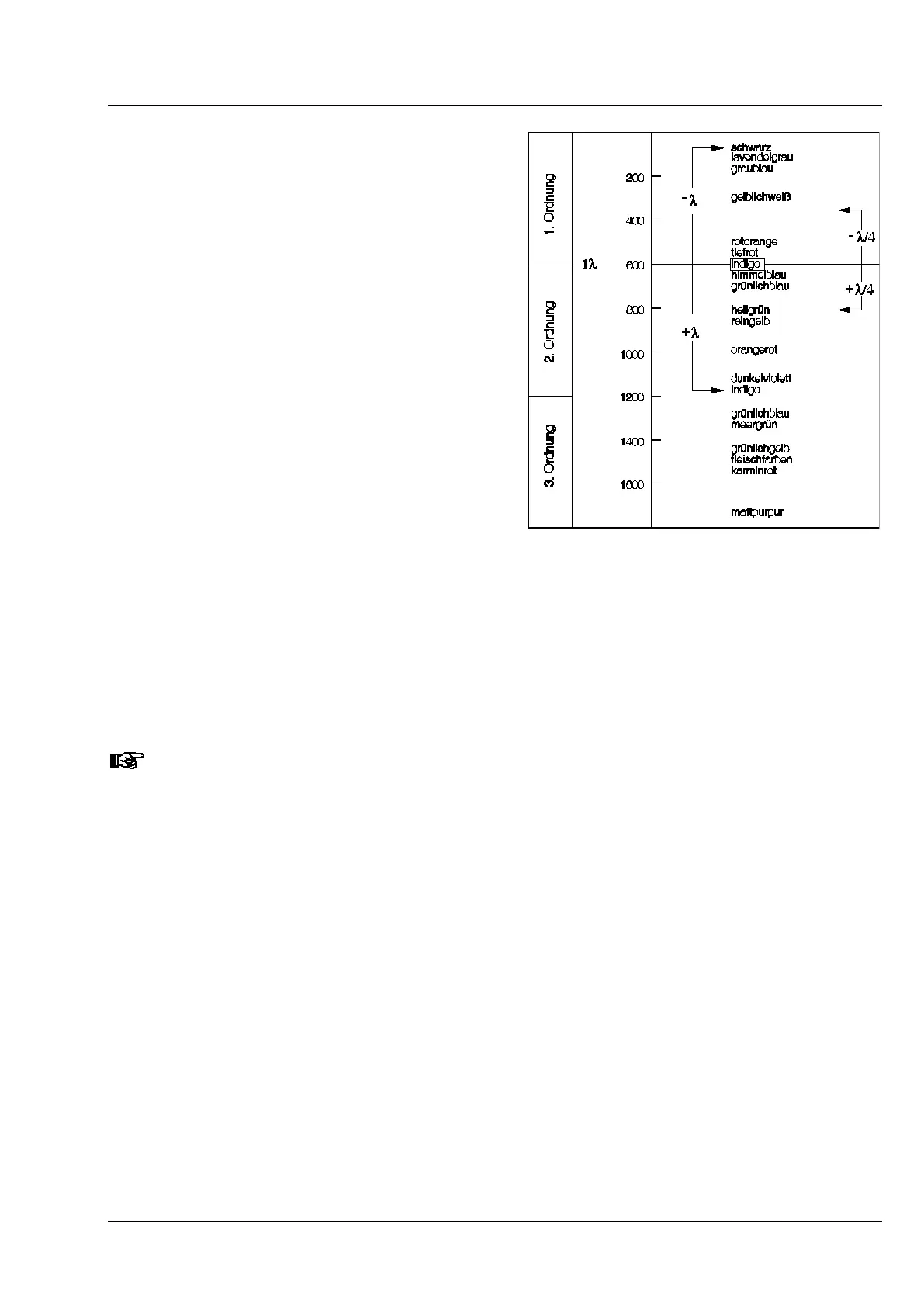
according to the Michel-Lévy color chart (Fig. 201).
When the compensator λ is brought into the light
path, the non-birefringent "surroundings" of the
synthetic fiber appear in a dark red color, which
corresponds to the path difference of the
compensator of 550 nm (1st order interference
color for the path difference of 550 nm
corresponds to 1 λ).
If the vibration direction (n
γ
or n
γ
') of the
birefringent specimen to be examined is parallel to
the principal vibration direction (n
γ
) of the
compensator λ, i.e. NE-SW, the path difference of
the specimen (e.g. grayish-white: 150 nm) and the
path difference of the compensator λ (red:
550 nm) are added together. This results in a color
change of the specimen from grayish white to
greenish-blue (resulting path difference = 700 nm).
If the vibration direction of the specimen to be examined is perpendicular to the principal vibration
direction of the compensator λ, i.e. NW-SE, the path difference of the specimen (e.g. grayish-white:
150 nm) is subtracted from the path difference of the compensator λ (red: 150 nm). In this case, the
interference color of the specimen visibly changes from grayish-white to orange (resulting path difference
= 400 nm).
Color charts according to Michel-Lévy are available under Cat. No. 42-312.
Fig. 201 Schematic diagram of the color
charts according to Michel-Lévy



 To Next Page