4.3.2 Defibrillation Operation
Confirm that the patient has suffered a cardiac arrest, and is in a non-breathing,
non-pulsatile, non-responsive condition:
1. Undo the patient's clothing, cut, or remove excessive chest hair and wipe the chest
clean if necessary.
2. Use the anterior-anterior pad placement position to attach the multi-function pad to
the patient as indicated on the pad package.
3. Connect the multi-function pad to the pad cable. Insert the pad cable into the therapy
port of the device and tighten it until it clicks into place.
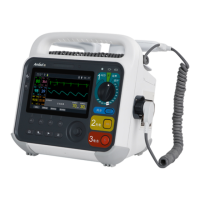
4. Turn the Defibrillator Monitor mode selection switch to AED. After entering the AED
mode, the Defibrillator Monitor continuously checks the connection between the electrode cable
and the multi-function pad. When there is an abnormal connection, the Defibrillator Monitor will
display a prompt in the AED information area until the connection is normal.
5. Follow the voice and prompts. The Defibrillator Monitor automatically analyzes the
patient's rhythm type from the ECG waveform monitored by the multi-function pad and will give
a warning that the patient should not be contacted. If a shockable rhythm is detected, the
Defibrillator Monitor will be automatically charged. The voice prompt can be set to Off or On in
System settings. Please refer to 3.3.3 to select the voice volume level.
6. If there is a shock prompt, press the Shock button. When charging is complete, the
Defibrillator Monitor will issue the prompt of "Do not contact the patient! Press the shock
button". Ensure that no one is in contact with the patient and that no accessories and no contact
with accessories, equipment, etc. are connected to the patient, and shout "stand aside" loud and
clear. Then press the Shock button on the device panel to deliver a shock to the patient.
7. After the shock is delivered, the Defibrillator Monitor will give a voice prompt and text
message "Shock released," and the shock counter on the screen will be updated to reflect the
number of shocks that have been performed. If the [Stacked Shocks] in [Basic Configuration] is
set to a value greater than 1, the defibrillator monitor will restart to analyze the patient's rhythm
after one shock, and judge whether the shock is successful. Meanwhile, a voice and text message
will prompt you to continue guiding you to complete more shocks.
Caution:
• For defibrillation in children under 8 years old, it is recommended to use pediatric pads.
When there are no pediatric pads, use the adult pads and set Patient Category to [Child].
• During heart rate analysis, keep the patient stationary to prevent misdiagnosis or
delayed diagnosis.
• The defibrillator monitor does not automatically deliver a shock so the shock button
must be pressed to deliver a shock.
• Avoid interfering with the patient's treatment due to high impedance. When the


 To Next Page