waveforms and parameter values on the screen. The i6 supports the monitoring of ECG signals
with 3- and 5-lead ECG lads, external defibrillation paddles, and multi-function pads. When the
ECG lead is connected to the external defibrillation paddles or multi-function pads, the
Defibrillator Monitor will display the ECG waveform from one of them according to the system
settings.
Warnings:
• Periodically check the skin where ECG electrodes, pads, or pads are placed. If there are
signs of allergy, replace the electrodes or change the placement of pads or pads.
• If defibrillation is required, an anti-defibrillation ECG cable should be used.
• The patient's pacing status should be set correctly, otherwise for patients with
implanted pacemakers, the pacemaker pulse may be counted in the event of cardiac arrest and
certain arrhythmias. Patients with implanted pacemakers should be closely observed and should
not rely exclusively on the heart rate alarm and the displayed heart rate.
Caution:
• When placing electrodes or connecting the cables, make sure there is no contact with
other conductive parts or the Earth. Ensure that all ECG electrodes are attached to the patient.
• Interference from ungrounded instruments near the patient and ESU interference may
cause an ECG waveform distortion.
• The ECG waveform is displayed as a dashed line if a valid ECG signal is not available
from the chosen ECG signal source
• Use of external defibrillation paddles for ECG monitoring should be avoided.
• When ECG monitoring is performed using cardiac leads, the electrodes used must be of
the same type.
• The Defibrillator Monitor cannot be used for direct cardiac contact during ECG
monitoring.
6.2 Monitoring Screen
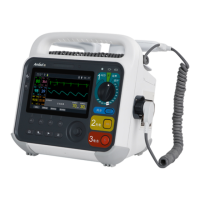
The following figure shows the ECG monitoring screen. As shown here, up to two ECG
waveforms can be displayed on the monitoring screen, along with heart rate and all other
available parameter values, as well ass valid alarm settings.


 To Next Page