patient.
Caution:
• When the internal defibrillation paddles are used, the maximum energy value that can
be selected is automatically limited to 50J to prevent from damaging the heart.
• Always sterilize before using the internal defibrillation paddles, otherwise, it can cause
serious infections.
• The internal defibrillation paddles must be cleaned after each use.
5.5 Manual Synchronous Defibrillation
Synchronous defibrillation can be performed in two ways:
• Multi-function pads
• Paddles
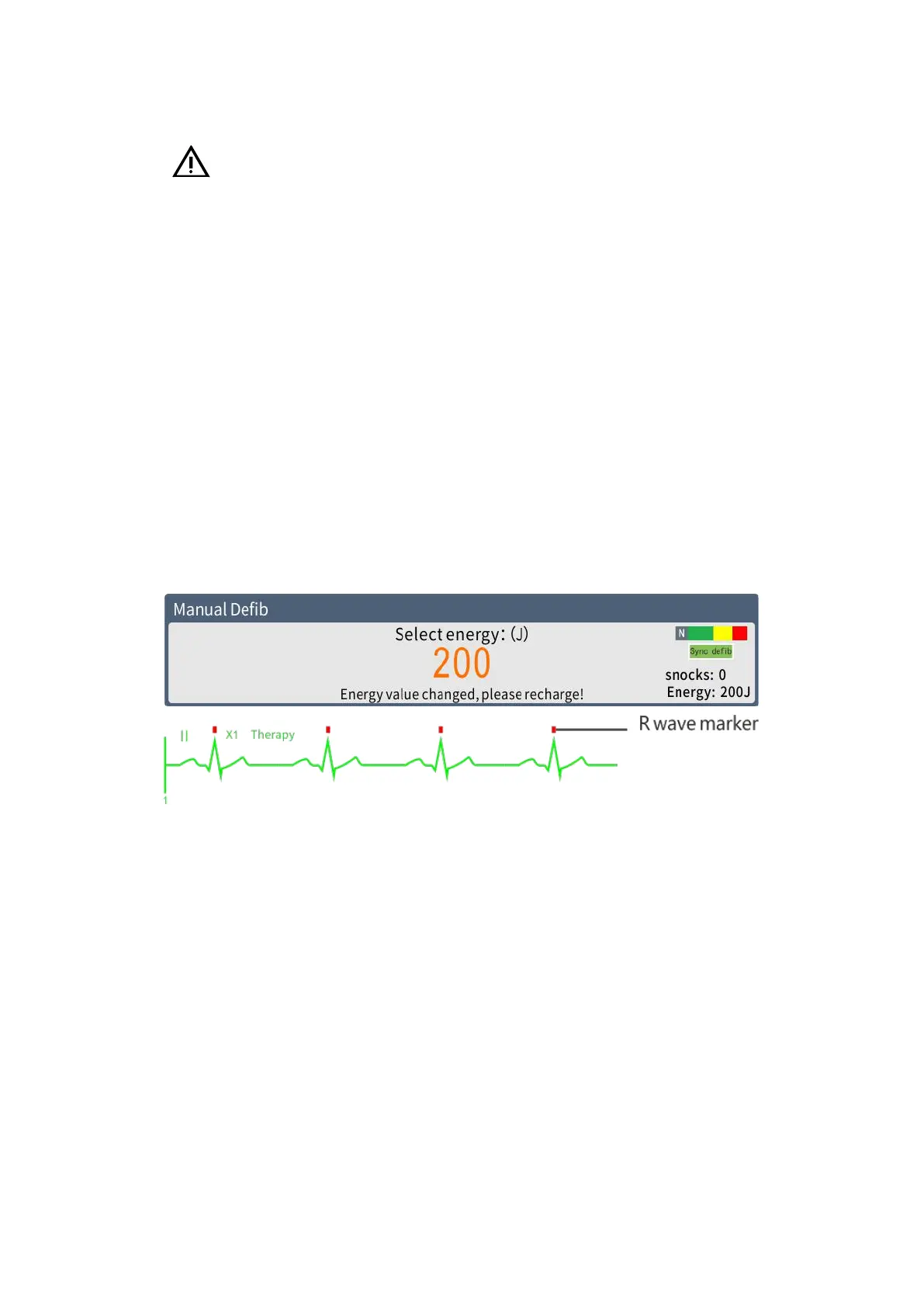
In the manual defibrillation mode, press the [Sync] button on the Defibrillator Monitor
screen to enter the synchronized cardioversion mode. The Defibrillator Monitor will display the
synchronization sign in the manual defibrillation information area and display an R wave sign
above each detected R wave of the ECG waveform. As shown in the figure below:
5 - 6 R wave marker
When performing synchronous defibrillation, use a 3-lead or 5-lead ECG electrode to
monitor the ECG waveform, because the paddles are susceptible to external interference, which
would cause incorrect R waves. Deliver a shock through the multi-function pads or paddles.
5.5.1 Manual Synchronous Defibrillation Steps
1. Connect the treatment cable and place the paddles/multi-function pads; If ECG
monitoring is performed through the ECG lead, connect the ECG cable, and place the ECG
electrode. Refer to "6.4 ECG Lead Monitoring".
2. In the manual defibrillation mode, press the [Sync] button to enter the synchronized
cardioversion mode.
3. Select Lead. The selected lead waveform must have a clear signal and a large QRS wave
group.
4. Verify that the R wave marker appears above the R wave. If the R wave marker does not


 To Next Page