10 NIBP Monitoring
10.1 Overview
The non-invasive blood pressure monitoring method includes the Kirschner sound method
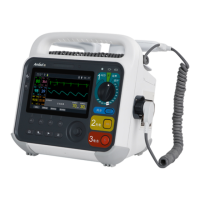
(manual) and oscillation method. The Defibrillator Monitor adopts the oscillation method to
measure the non-invasive blood pressure (NIBP), which applies to adults, children, and neonates.
NIBP monitoring values include systolic blood pressure (SBP), diastolic blood pressure (DBP) and
mean arterial pressure (MAP). To understand how oscillation method works, it can be compared
to the auscultatory method.
Directly Monitored
Objects
AMP = (SBP + 2 × DBP) ÷ 3
SBP: MAP ÷ 0.55
DBP: MAP × 0.85
NIBP measurement can be performed during electrosurgery and during defibrillation
discharge.
The blood pressure value measured by the Defibrillator Monitor is equivalent to that
measured by the Korotkoff-Souna method or invasive method, and the error meets the
requirements specified in YY0667-2008.
The clinical significance of NIBP measurements must be determined by the physician.
NIBP measurements are performed by inflating the cuff to apply pressure to the measured
portion of the patient and the physician should judge whether the patient is suitable for NIBP
measurement according to the actual conditions.
Warnings
•
Patient category must be confirmed before the measurement is performed. Incorrect
settings may endanger patient safety, as a higher level of adult settings are not available for
pediatric and neonatal use.
•
NIBP measurement should not be carried out on patients with sickle cell disease, who
have or are expected to have skin damage.
•
For patients with the severe thrombotic disease, automated blood pressure
measurement must be determined according to the clinical situation, as there is a risk of
hematoma on the limb where the cuff is tied.
•
Do not place a cuff on a limb that has an IV infusion or a cannula, as it may cause tissue
damage around the catheter when the infusion is slowed or blocked during cuff inflation.


 To Next Page