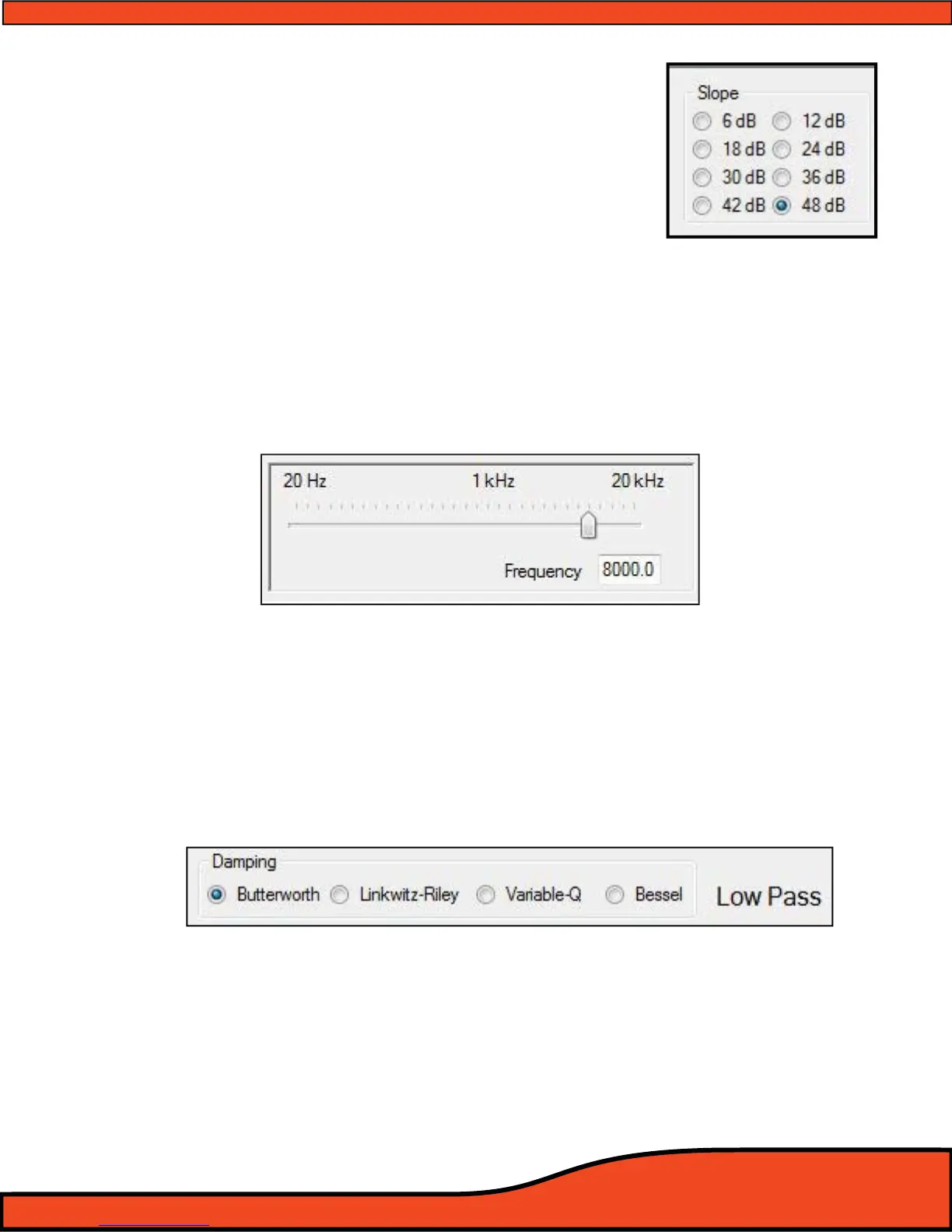
12.4.5.1 - LP Crossover Slop Selection Window
The PS8 oers users the ability to select between
6/12/18/24/30/36/42/48 dB slopes on all of its crossovers. To select
the desired crossover slope, simply click on the checkbox next to
the value you want. If on a band pass crossover, the slopes do not
have to match and can dier between the LP and HP operations.
(See diagram 12.25)
12.4.5.2- LP Crossover Frequency Selection Controls
The PS8 oers the most extensive selection of crossover frequencies available to the car audio market.
Available from 20.0hz to 20.0kHz, the PS8 gives users 199,800 dierent frequencies per band, per lter
type, to choose from. To select the desired Low Pass frequency you can simply type frequency in the
display readout, click on and drag the slider with your PC's pointer, or click on the slider and then adjust
incrementally with the arrow keys on your keyboard.
(See diagram 12.26)
12.4.5.3 - LP Crossover Damping Selection Window
Oering users traditional Butterworth and Linkwitz-Riley crossovers, the PS8 allows you to critique the
special needs of your individual system and its tuning parameters. Simply by clicking the designator
next to the desired damping type, you can assign either of the available damping lters to the particular
lter type of each channel of the PS8. When using band pass mode on the PS8 you may have dierent
types of damping on each portion of the channel you are on (For example Butterworth on HP and
Linkwitz-Riley on LP).
(See diagram 12.27)
When in advanced user mode
( users will also have access to Bessel and Variable "Q"
damping types. These Damping types are also mixable in BP mode and are only recommended for the
most experienced users. No tech support is oered on these damping features.
Diagram 12.25
Diagram 12.26
Diagram 12.27


 To Next Page