MANUAL ELDES ESIM264 V2.0 21
4.4 Wireless Devices
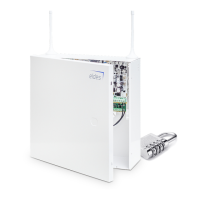
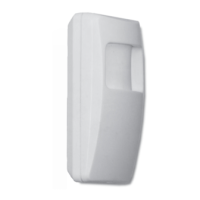
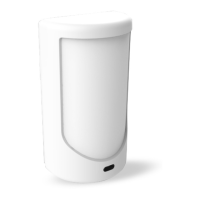
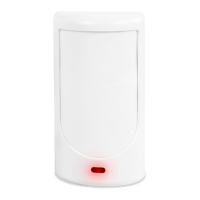
ESIM264 with installed EWT1 module operates as an access point for ELDES wireless devices: PIR movement sensor EWP1, expansion
module EW1, sirens EWS1 & EWS2, magnetic door contact EWD1 and key-fob EWK1. Up to 16 ELDES wireless devices located at up to
30 meters (up to 150 meters in open areas) radius range from ESIM264 alarm system with EWT1 can be connected at a time. Accord-
ing to wireless device type and quantity the system adds wireless zones (RF zones) and wireless PGM outputs (RF outputs), therefore
totally 32 wireless zones and/or 32 wireless PGM outputs can be added to the system. ELDES wireless connection operates at 868MHz
non-licensed frequency. For more details, please, refer to chapter 8. ELDES Wireless Devices.
4.5 RS485 Interface
ESIM264 has an RS485 interface supporting up to 4 EKB2 and/or EKB3 keyboards. This feature allows to install more than one alarm
system control point in the secured area in order to be able to arm and disarm the alarm system at several entrance points.
The RS485 interface is also intended for EPGM1 module connection and data channel connection to monitoring station.
For more details, please, refer to chapter 7. Wired Devices.
4.6 1-Wire® Interface
The implemented 1-Wire® interface enables the iButton® key reader connection to ESIM264. The system supports unlimited quantity
of iButton® key readers. For more details, please, refer to chapter 7.7 iButton® Key Reader & Keys.
1-Wire® interface is also intended for temperature sensor connection. Only 1 temperature sensor can be connected to ESIM264 sys-
tem. For more details, please, refer to chapter 5.4.12 Temperature Change Notications.
In order to assure a stable signal between the connected iButton® reader/temperature sensor and 1-Wire® interface, the cable length
must not exceed 30 meters.
4.7 Backup Battery, Main Power Failure & Memory
The system supports a backup battery maintaining system power supply in case of main power failure. In addition the implemented
battery status feature checks the backup battery resistance once a day and sends an SMS report to all preset users on battery replace-
ment in case more than 1,5Ω resistance is detected. This feature is permanently enabled and cannot be disabled manually.
NOTE: Backup battery is optional and does not come in standard package.
The conguration settings and event log records are stored in a built-in EEPROM memory, therefore even in case of full system shut
down, the conguration and event log remains saved.
ATTENTION: It is forbidden to switch backup battery pole terminals places, otherwise this will lead to blown fuse.
For more details, please, refer to chapter 5.4.13 Main Power Supply Status Notications.
4.8 Communication with Monitoring Station
GSM alarm system ESIM264 supports data transmission to monitoring station by the following meth ods: Voice Calls (GSM audio
channel), GPRS network, RS485 data channel or CSD (Circuit Switched Data). All of these data transmission methods can be set as
primary or backup communication in any sequence order. For more details, please, refer to HELP section of ELDES Conguration Tool
and chapter 9. Monitoring Station.
4.9 GSM Loss Indication
ESIM264 alarm system features an indication when the GSM signal is lost. In case of such failure, the system not only turns o the
NETWORK LED, but also turns on the specied PGM output if the GSM signal is lost for longer period than the set delay value. The
PGM output is turned of once the GSM signal is restored. This feature can be congured using ELDES Conguration Tool software. For
more details, please, refer to software’s HELP section.
4.10 Partitions
ESIM264 supports 2 partitions (PART0 - partition 0 & PART1 - partition 1) dividing the alarm system into 2 separate system sections.
Every system partition operates independently from each other, therefore this feature is useful for securing 2 dierent areas by using
1 alarm system unit. By default all users, zones, user (keyboard) passwords, keyboards, iButton® keys are assigned to partition 0. For
more details, please, refer to chapter 5.4.16 Partitions.



 To Next Page