Relevant modes:
(1) Linear speed input module: It has two functions: calculating the synchronous frequency in torque
control according to the linear speed and calculating the roll diameter according to the linear speed.
(2) Tension setting module: Used to set the tension adapting to the control system. It needs to be
adjusted according to the actual situation. After confirmation, the value remains the same. In some
scenarios where the forming effect after winding needs to be improved, the tension taper function can
be used so that the tension decreases as the roll diamter increases.
(3) Real-time roll diameter calculation module: The calculation accuracy of roll diameter determines
the control performance. The roll diameter can be calculated according to the inverter output
frequency and the linear speed. In addition, it can also be calculated through the thickness or sensor.
The linear speed is widely used for the calculation. If the set linear speed is used for the calculation,
you you choose whether to enable the function of roll diameter change limiting.
(4) Torque compensation module: Torque compensation includes friction torque compensation and
inertia torque compensation. Friction torque compensation is used to eliminate the impact of friction
on tension, and it needs to be adjusted according to actual requirements. rRotation inertia includes
inertial of mechanical systems and that of materials. To keep the tension stable in ACC/DEC,
compensation torque is required. In some cases, without strict tension control requirements, disabling
rotation inertia torque compensation can also achieve the control.
(5) Material feeding interrupt detection and processing module: The function is valid when material
feeding interrupt detection has been enabled.
(6) This function is applied to automatic reel change. After the inverter is started if the pre-drive
function terminal is valid, the roller runs at the set linear speed. When the terminal is invalid, the
inverter will automatically switch to the corresponding control mode after a period.
5.5.20.4 Closed-loop torque mode
Similar to the open-loop torque mode, the closed-loop torque mode has only the difference that
tension detection sensors are installed on the winding/unwinding side. In addition to all the function
modules supported in open-loop torque mode, this mode supports an additional tension feedback PID
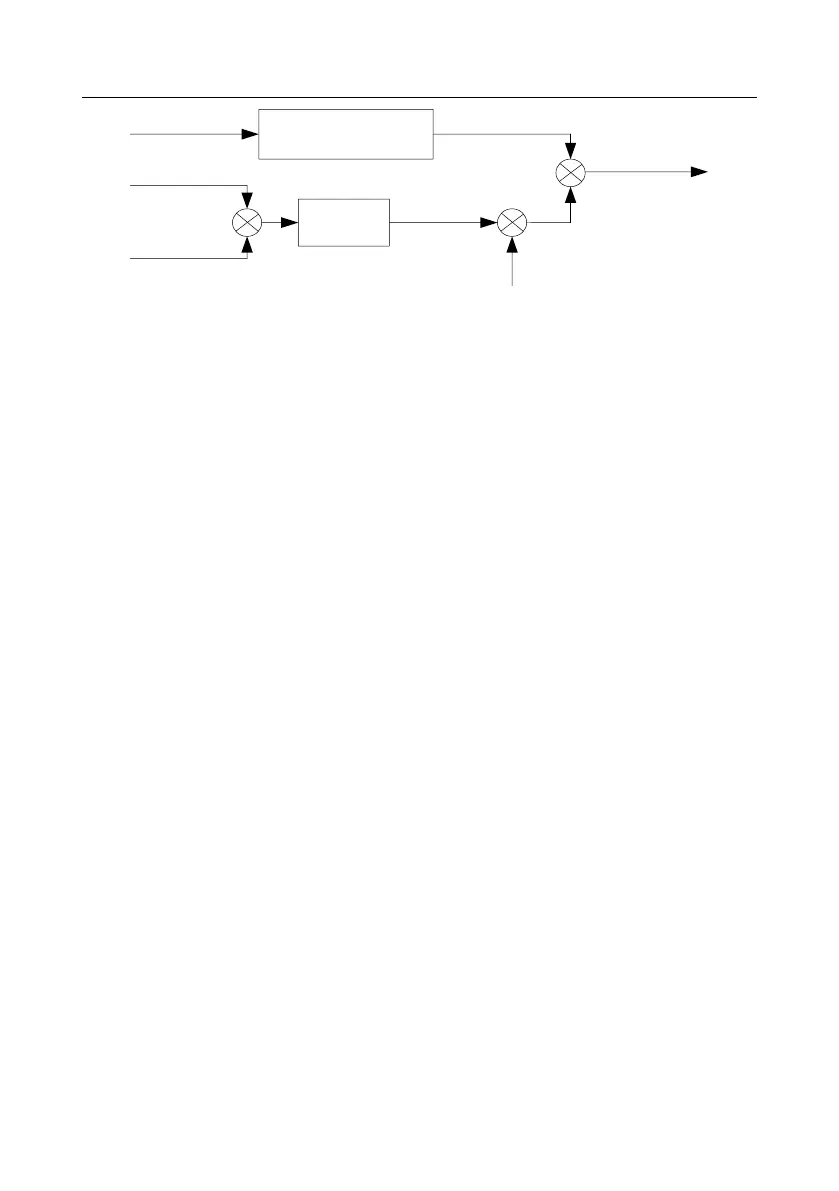
closed-loop regulation module. The control principle is shown in the following figure.


 To Next Page