HD2 Series Inverter Function Parameter List
-159-
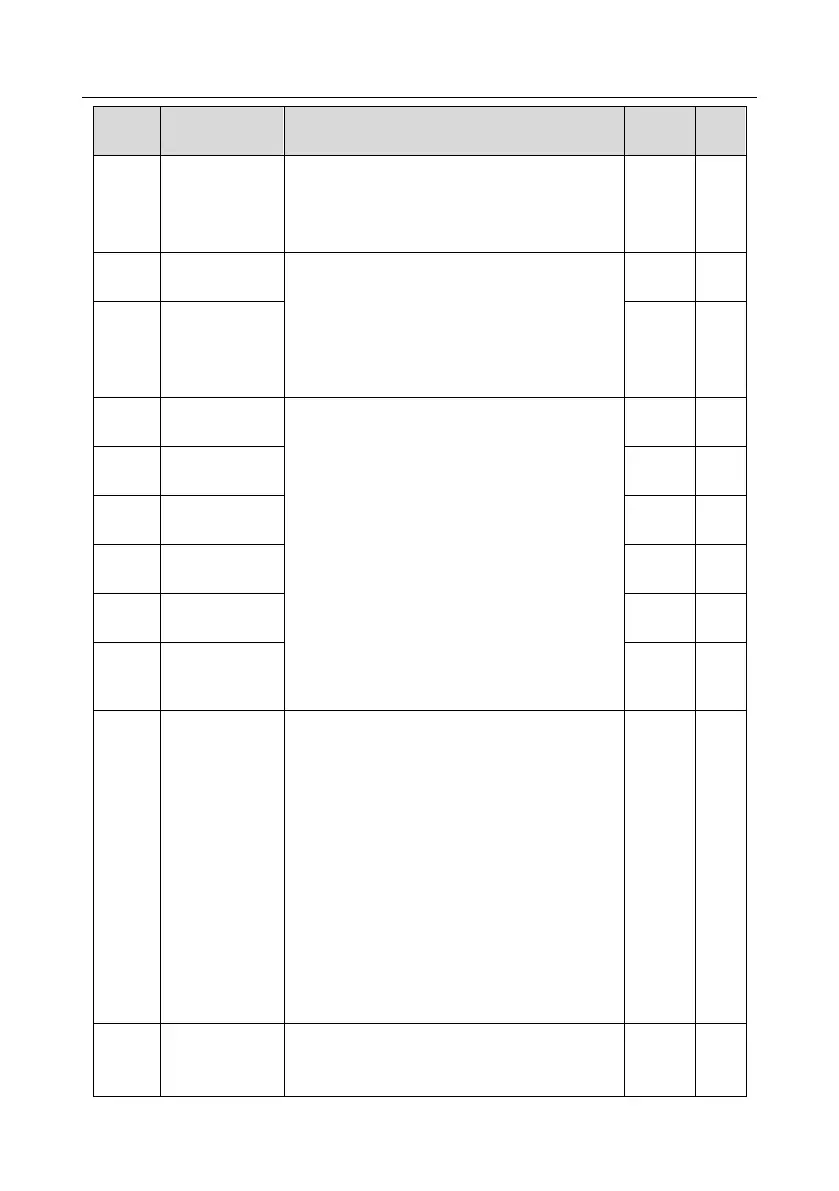
2: Torque-down V/F curve (power of 1.3)
3: Torque-down V/F curve (power of 1.7)
4: Torque-down V/F curve (power of 2.0)
5: Customize V/F (V/F separation)
Note: Refer to the parameter description of
P04.01 and P04.02.
Setting range of P04.14: 0.0%: (automatic) 0.1%–
10.0%
Setting range of 0.0%–50.0% (relative to rated
frequency of motor 2)
Torque boost
cut-off of motor 2
V/F frequency
point 1 of motor 2
Note: Refer to the parameter description of
P04.03–P04.08
Setting range of P04.16: 0.00Hz–P04.18
Setting range of P04.17:0.0%–110.0% (rated
voltage of motor 2)
Setting range of P04.18: P04.16–P04.20
Setting range of P04.19: 0.0%–110.0% (rated
voltage of motor 2)
Setting range of P04.20: P04.18–P12.02 (rated
frequency of asynchronous motor 2) or P04.18–
P12.16 (rated frequency of synchronous motor 2)
Setting range of P04.21: 0.0%–110.0% (of the
rated voltage of motor 2)
V/F voltage point
1 of motor 2
V/F frequency
point 2 of motor 2
V/F voltage point
2 of motor 2
V/F frequency
point 3 of motor 2
V/F voltage point
3 of motor 2
V/F slip
compensation
gain of motor 2
This parameter is used to compensate for the
motor rotating speed change caused by load
change in the SVPWM mode, and thus improve
the rigidity of the mechanical characteristics of the
motor. You need to calculate the rated slip
frequency of the motor as follows:
△f=fb-n*p/60
where fb is the rated frequency of motor 2,
corresponding to P12.02; n is the rated speed of
motor 2, corresponding to P12.03; p is the number
of pole pairs of motor 2. 100% corresponds to the
rated slip frequency △f of motor 2.
Setting range: 0.0–200.0%
Low-frequency
oscillation control
factor of motor 2
In the SVPWM mode, current oscillation may
easily occur on motors, especially large-power
motors, at some frequency, which may cause


 To Next Page