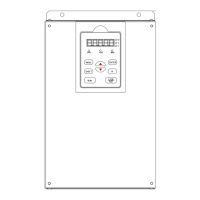
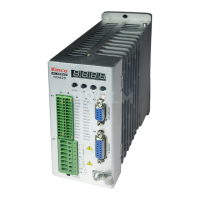
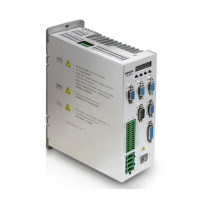
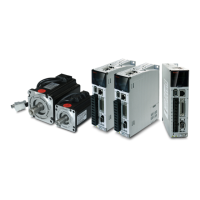
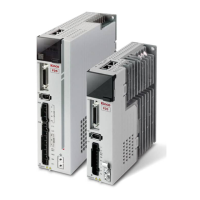
FD5
series drives
RS-232C communication strictly follows the master-slave protocol, Kinco servo+ can
send any data to drive.
The drive sets the address to calculate these data and respond with a return
value.
The default communication parameters of FD5 series servo are as follows:
Baud rate = 38400 bps
Data bit = 8
Stop bit = 1
No verificaiton
The communication ID can be set through the device station number d5.01, and the baud rate can
be set through d5.02. After setting, the baud rate must be saved by setting d5.00. The changed
baud rate and ID will be restarted in the drive. effective later.
RS232
The transport protocol used is in a fixed ten-byte packet format:
CHKS = -SUM(byte0……byte8)
,
CHKS
are the last two digits
of the calculation result
Host sending:
Servo sending or host recieving:
10.1.4 RS232 Data protocol
The data protocol is different from the transmission protocol, and its content refers to 8 data bytes
out of the 10 bytes above. The internal data definition of FD5 series servo drives conforms to the
CANopen international standard. Values and functions are expressed by indices and sub-indexes.
A:Downloading(From master to slave)
Attention
⚫ When the host computer is connected through a baud rate of 115200, due to the high
frequency of transmission signals, there are certain requirements for the
communication environment. If there is a disconnection or frame loss, it is
recommended to reduce the communication baud rate to connect to the host computer
software.
Attention
⚫
There is an independent CHKS for every ten Bits.
⚫
If the host sends an address that does not exist in the network to the servo
drive, the servo drive will not respond
.
⚫
When the master sends a correct data, the slave will look for the slave data of
the corresponding address and check the check value. If the check value does
not match, the slave will not respond
。

 To Next Page
 Loading...