Chapterl 1: System Description LB 9507
1-4
Kinetic measurements
There are three ways to perform kinetic measurements:
1. Using a “RAW DATA" measurement protocol or a "Direct
Entry” measurement which is not stored in the instrument
memory. This kind of measurement provides always a fixed
measurement time. The results can be printed out, or
received on the RS 232 port of a computer. The Berthold
"WinTerm" program is suitable to receive and transfere the
results into Microsoft Excel.
2. Using a “REPEATED” measurement protocol to set up the
injector and timing intervals in combination with a stored
protocol. The results can be printed out, or received on the
RS 232 port of a computer. The Berthold "WinTerm" program
is suitable to receive and transfer the results into Microsoft
Excel.
3. Using continuous measurement in “RATEMETER” mode.In
this mode results are continuously produced until the
measurement is stopped by the user. Results can be printed
out, or received on the RS 232 port of a computer.The
Berthold "WinTerm" program is suitable to receive the results
and transfer them into Microsoft Excel.
The measurement procedure
The measurement procedure is defined by the user in
measurement protocols. The integrated software controls the
measurement and evaluation steps, and displays messages and
instructions for the user. Lumat is a semi-automatic system that
requires only a few simple actions by the operator; this is
supported by an ergonomically sensible arrangement of controls
on the front of the instrument.
To perform a measurement you must observe a simple procedure
which is controlled by the software. If you do not follow this
procedure, error messages will be produced accordingly.
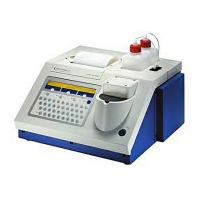
The sample chamber and the sample holder form a single unit.
The sample holder contains 2 holes, each for one sample tube,
and sits on the round measurement chamber as a rotating block.
It is turned in 180° steps by the integrated software, moving one
hole in front of the photomultiplier (measurement position) and the
other into the loading position (see Fig. 1-1).


 To Next Page