LB 9507 Chapter 1: System Description
1-1
1. System Description
1.1 Application
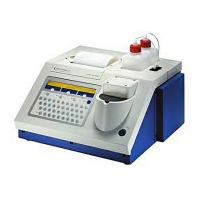
The Lumat LB 9507 is a semi-automatic, user-friendly
luminometer for universal use in bio- and chemiluminescence.
Equipped with up to 2 reagent injectors, a highly sensitive
photomultiplier, flexible software and a highly advanced, easy-to-
handle mechanical system, Lumat is excellently suited to
applications such as ATP measurement, immunoassays, DNA
probe assays, calcium measurements and reporter gene assays.
Qualitative classification of unknown samples using the ”cut-off
method” can also be performed.
A specially developed rotating sample holder and transport
system for 2 test tubes allows samples to be measured and
loaded in parallel. This almost doubles the sample throughput
during the normal measurement duration of 5 to 10 seconds, thus
equalling the speeds reached by automatic systems.
The Lumat software has been tailored to the user’s specific needs
and the processes of luminescence measurement. Essentially, it
is divided into 6 basic parts:
1. Raw data measurement
In this measurement mode, the quantity of light measured in RLU
units over a user-defined measuring time is produced for each
sample. The mean value and the coefficient of variation are
generated for replicate groups. You have the option of printing out
a high resolution (up to 2000 data points) curve and 20 data
points with time scale for each sample, which enables you to
analyze the kinetic behaviour of the light emission of a sample.
This measurement mode, which allows up to 2 injections per
sample, is mainly used for ATP measurements or for measuring
luminescence reporter gene assays.
2. Cut-off measurements
Using negative and positive standards, unknown samples are
classified quantitatively by interpreting the results of the
measurements on the basis of predefined RLU limits.
3. Quantitative measurements (LIA, ILMA...)
Known standard concentrations are measured before the
unknown samples. After transformation of the calibration curve
(either log-log or logit-log), the program interpolates standards
and unknown samples. Instead of using the standard
concentrations, you can also enter the values from a master curve
which is defined by the reagent manufacturer.


 To Next Page