LB9507 Appendix
5
A.1.3 Spline Function
The spline polynomial g
i
(x) is calculated according to the formula:
n: number of standards
x: standard concentration
i.e. the waviness of the resulting curve will be minimized, and
gx
i
i
n
() - y
y
S
i
i
2
δ
êú
≤
=0
i.e. the sum of the squares of the deviation between the calculated
spline curve and the original standard points y
i
, with regard to the
calculated relative measuring and statistics error δy
i
of all standard
points is smaller than the smoothing factor S.
The
automatic smoothing function of Lumat ensures that,
beginning with smoothing factor 0, the standard curve in the lin-
log plot (which is only used for this!) is checked. It must have
either no turning point or just one. If this is not the case, the spline
coefficients are calculated again with a higher smoothing factor
and then the quality of the resulting curve is checked again. If the
maximum smoothing factor is reached and the curve still does not
meet the specified requirements, the standard curve is considered
incorrect and the user may have to correct the individual values.
PLEASE NOTE:
Before calculating the spline curve, the standards are checked for
strict monotony (rising or falling, according to the curve type). If
you notice any irregularity, edit the curve before running further
measurements, or disregard this option by pressing CONTINUE.
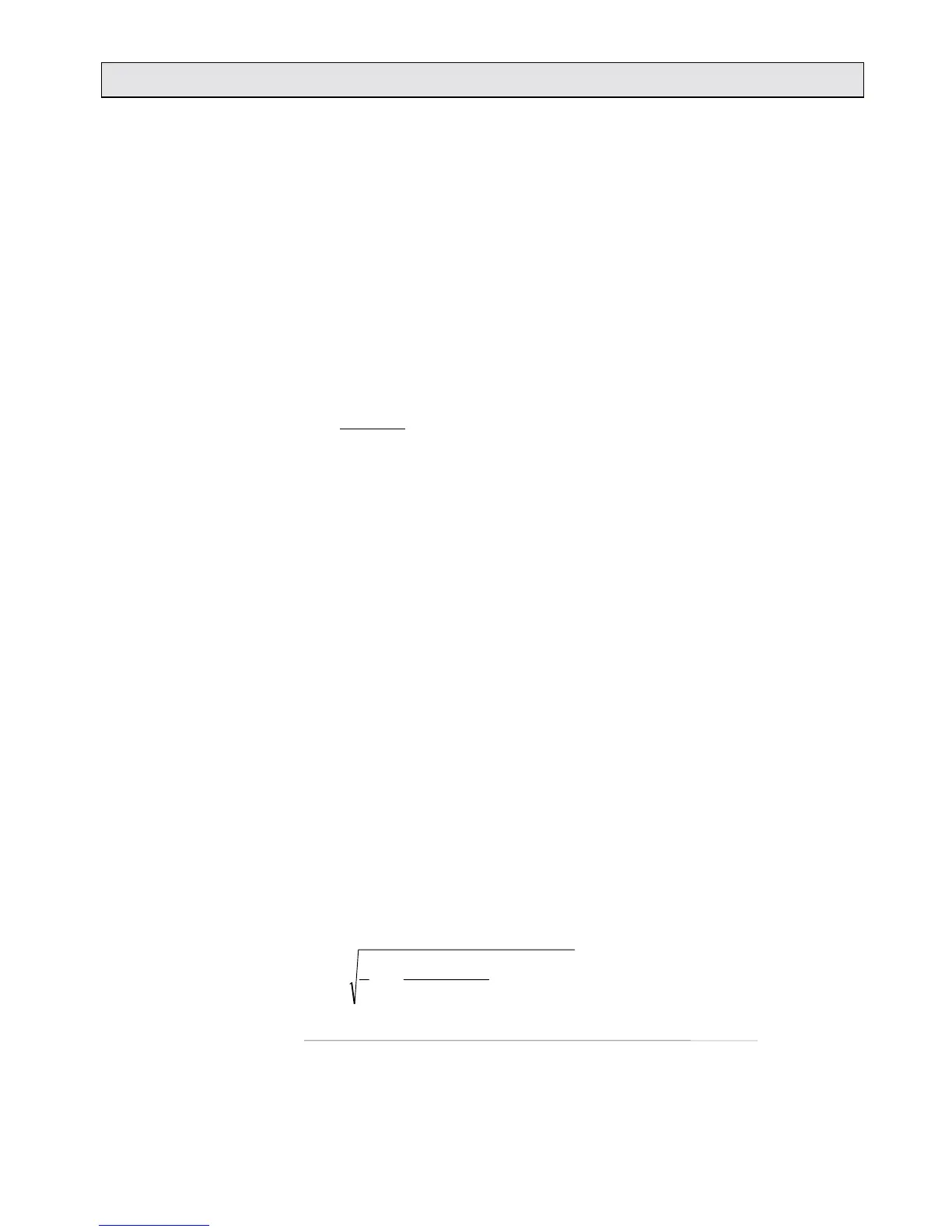
For a smoothed standard curve the goodness of the curve fit is
printed out as DEVIATION OF FIT, i.e.
G
x
x
s dard
sdard
i
i
=
1
n
- x
100 (%)
i
i=1
n
2
tan
tan
ê
ê
ú
ú
•
The SPLINE polynomial g
i
(x) is calculated according to the algorithm by
REINSCH, Num. Math. 10, 1967, pp. 177-183.
[]
gdx
x
X
n
"min (x)
2
0
→



 To Next Page