B DFT Models
Kelvin Equation with Broekhoff-de Boer Thickness Curve
N2 - Broekhoff-de Boer Model
Geometry: Cylinder
Substrate: Average
Category: Porosity
Method: Nitrogen 77 K
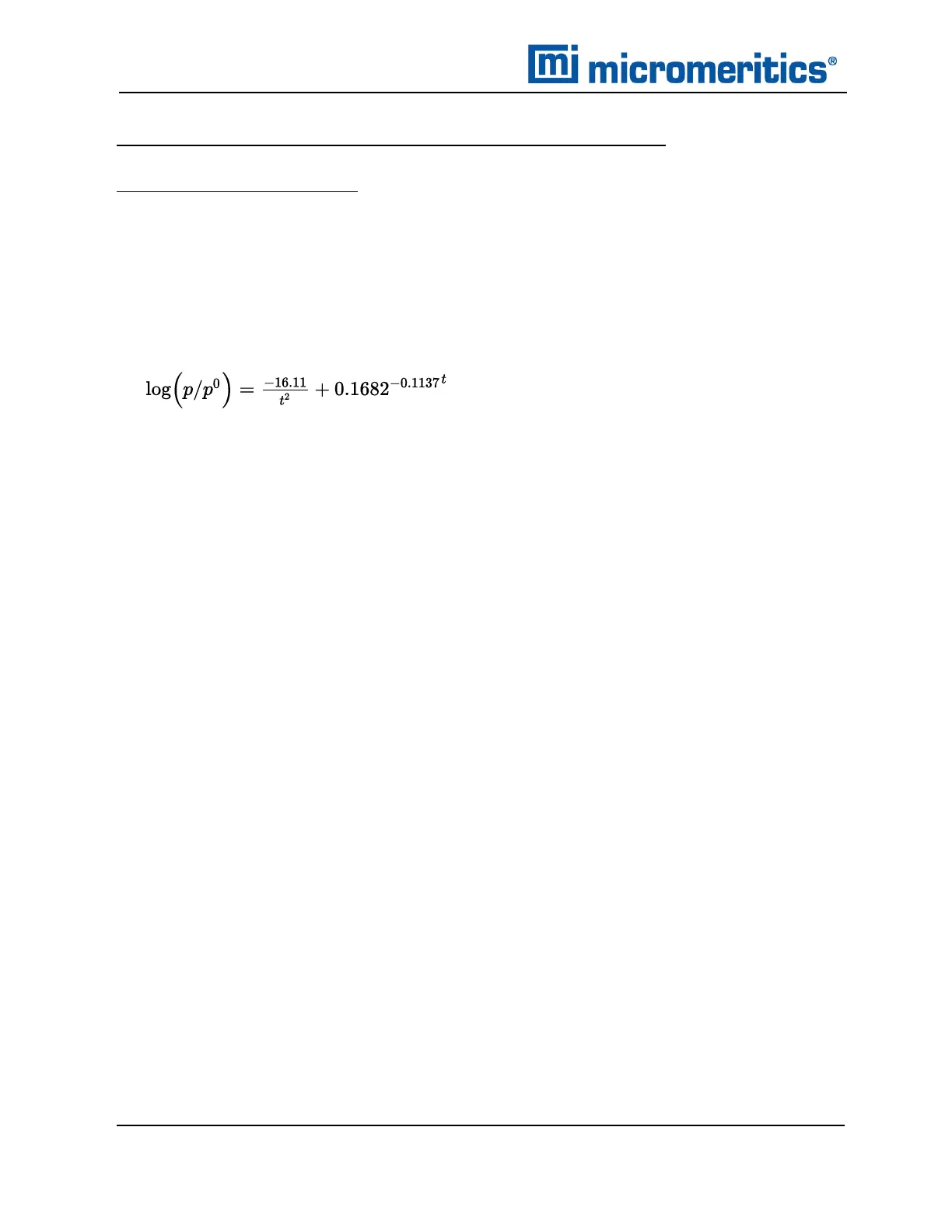
The kernel function is calculated using the Broekhoff-de Boer equation with standard parameters:
The nitrogen properties used in the Kelvin equation are:
Surface tension = 8.88 dynes cm
-1
Molar density = 0.02887g cm
-3
N2 - Broekhoff-de Boer Model
Geometry: Cylinder
Substrate: Average
Category: Porosity
Method: Nitrogen 77 K
The calculation is similar to the above except that cylindrical geometry is assumed, and the film
thickness depends on pore size (see reference).
References: Specifically, equations 20 and 21 in: J.C.P. Broekhoff and J.H. de Boer,
“The Surface Area in Intermediate Pores,” Proceedings of the Inter-
national Symposium on Surface Area Determination, D.H. Everett, R.H.
Ottwill, eds., U.K. (1969).
DFTMODEL REFERENCES
The papers listed below provide additional information on DFT models:
1. “Determination of Pore Size Distribution from Density Functional Theoretic Models of
Adsorption and Condensation within Porous Solids,” J.P. Olivier and W.B. Conklin, Micro-
meritics Instrument Corp; presented at the International Symposium on the Effects of Sur-
face Heterogeneity in Adsorption and Catalysts on Solids, Kazimierz Dolny, Poland (July
1992).
B - 16
TriStar II Plus Operator Manual
303-42800-01 (Rev M ) — Sep 2023


 To Next Page
 Loading...