6 Functions and settings
Maschinenfabrik Reinhausen 201464 2374092/04 ENTAPCON® 260
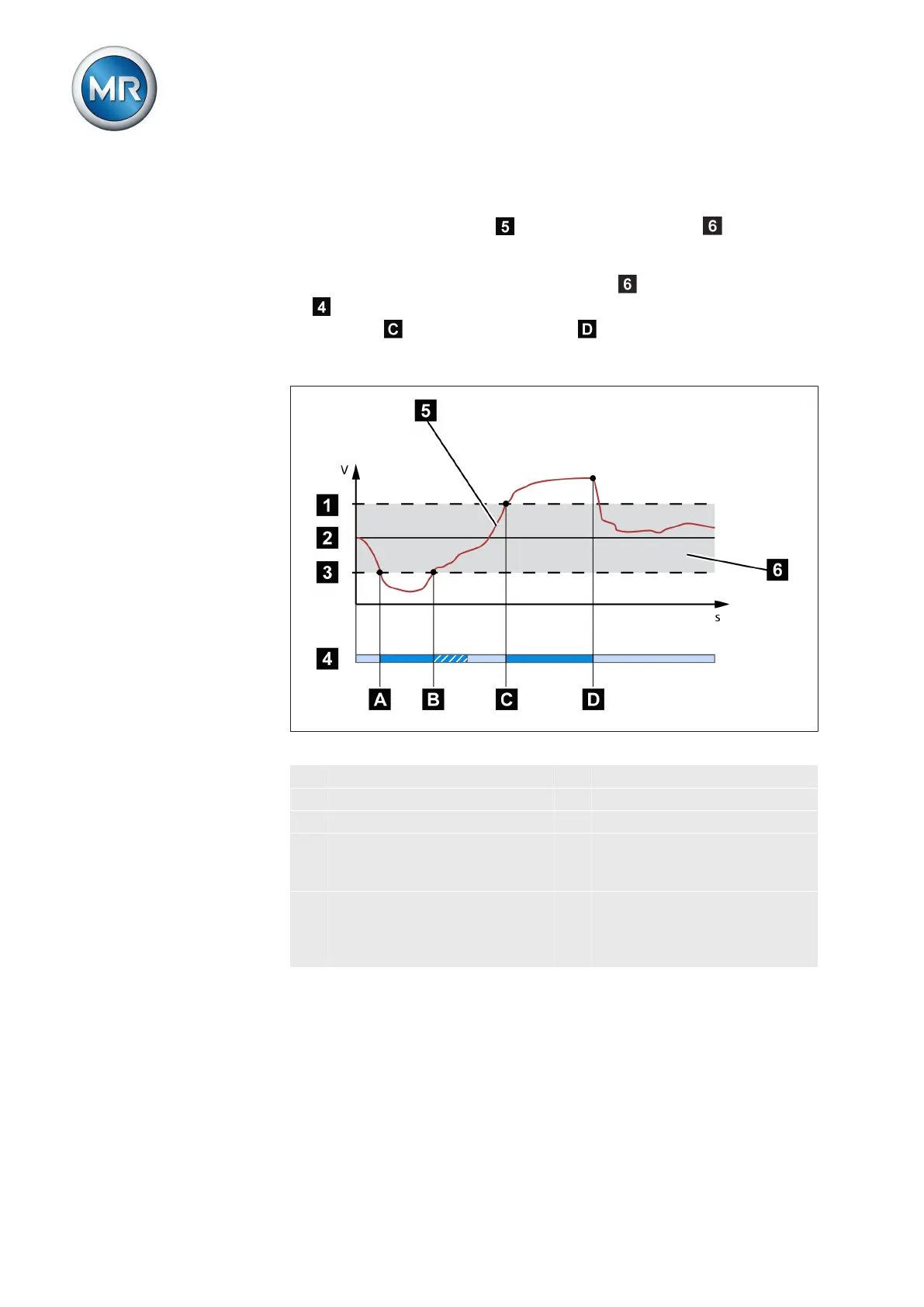
Behavior only with delay time T1
If the measured voltage U
actual
is within the set bandwidth , no control
commands are issued to the motor-drive unit for the tap-change operation.
Control commands will also not be issued to the motor-drive unit if the meas-
ured voltage returns to the tolerance bandwidth
within the set delay time
T1
. However, if the measured voltage deviates from the set bandwidth for
a long period
, a tap-change command occurs after expiration of the
set delay time T1. The on-load tap-changer carries out a tap-change in a
raise or lower direction to return to the tolerance bandwidth.
Figure 42: Behavior of the regulation function with delay time T1
1 + B %: Upper limit 4 Set delay time T1
2 U
desired
: Desired value 5 U
actual
: Measured voltage
3 - B %: Lower limit 6 B%: Tolerance bandwidth
A U
actual
is outside the band-
width. Delay time T1 starts.
B U
actual
is within the bandwidth
before delay time T1 is com-
plete.
C U
actual
is outside the band-
width. Delay time T1 starts.
D U
actual
is still outside the band-
width when delay time T1 is
complete. Tap-change opera-
tion is initiated.
Behavior with delay times T1 and T2
Delay time T2 can be used to correct major control deviations more quickly.
Ensure that you set a lower value in the "Delay time T2" parameter than in
the "Delay time T1" parameter.


 To Next Page