Copyright© Orphée SA. All Rights Reserved.
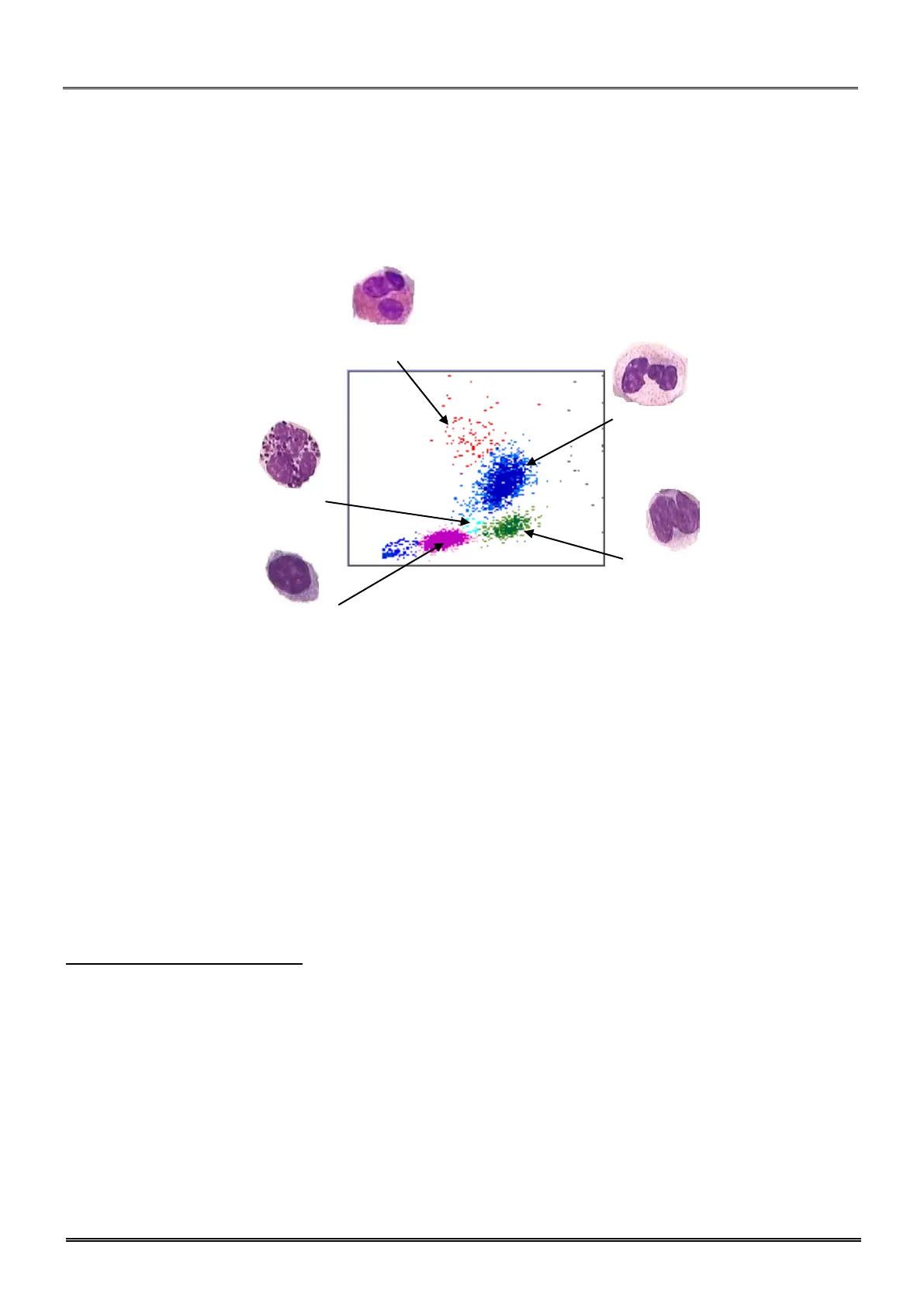
The five-part diff is obtained by the optical matrix analysis after action of the lytic reagent (pending
patent). This reagent destroys the RBC and their stroma, composes the oxyhemoglobin chromogen and
protects the white blood cell membrane to keep it in closed native state.
8.1.3 Hemoglobin measurement
The hemoglobin measurement is directly done in the WBC chamber, by spectrophotometry at 555 nm.
Hemoglobin is detected by formation of a chromogen oxy hemoglobin type (cyanide free technique).
A measurement of the blank of hemoglobin is done for each analytic cycle and during the start up rinsing
step.
An automatic offset circuit for the LED 555 nm allows maintaining the blank level at the same range. It is
not necessary to adjust this range with a potentiometer.
IMPORTANT NOTE TO READ:
In “standard” controls, calibrators or national surveys, hemoglobin is usually as methemoglobin form.
This conversion of hemoglobin is due to the chemical treatment that is performed in cells to stabilize them
(to enhance product’s lifespan). Indeed cells and plasma are treated with various components (fixative
agents, like aldehydes, preservatives, oxidizing agents, and sometimes even dyes).
All of those components are oxidative and progressively convert of all the hemoglobin into methemoglobin,
giving a typical brown hue to those bloods.
When used on standard instruments using Drabkin technique (or equivalent methemoglobin measurement
technique) this conversion of control hemoglobin into methemoglobin is not an issue. The reagents used in
those instruments just stabilize the methemoglobin which is already formed (stabilization complex depends
on the chosen ligand that is incorporated into the reagent).


 To Next Page