Configuring the Local Network
R81.10.X Quantum Spark 1500, 1600, 1800, 1900, 2000 Appliances Locally Managed Administration Guide|112
You define the Hotspot configuration in the Device > Hotspot page.
5. In DHCPv4 Server:
Select one of the options:
n
Enabled - Enter the IP address range and if necessary the IP address exclude
range. The appliance's own IP address is automatically excluded from this range.
You can also exclude or reserve specified IP addresses if you define network
objects in the Users & Objects > Network Objects page. To reserve specified IP
addresses, you must have the device MAC address.
n
Relay - Enter the DHCP server IP address. You can also enter a Secondary,
Tertiary, and Quaternary DHCP server IP address.
n
Disabled
IPv6 Auto Assignment for IPv6 configurations
n
SLAAC (Stateless Address Autoconfiguration) - The host selects its own full IPv6
address after it receives the IPv6 address prefix from the gateway. The appliance cannot
reserve an IPv6 address for a specific host (Mac Address).
Note - The common use case is a prefix length of 64. If you change it from 64,
make sure the internal hosts support the new length.
n
DHCPv6 Server - Same as the DHCPv4. You can reserve an IP address for a specified
host.
n
DHCPv6 Server Relay - Same as in IPv4.
n
Disabled (Static)
WAN as LAN
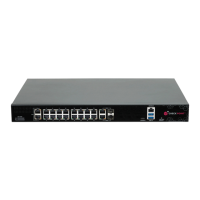
In the appliance, the two SFP ports are associated with DMZ and WAN. DMZ can already be
used for an internal-network, but WAN is reserved for internet-connections.
With this feature, you can use the WAN port, usually reserved for internet (external)
connections, for LAN (internal) connections. Some users prefer using SFP (fiber) for internal-
networks (LAN), as it is more reliable in an environment with high electrical power.
When assigned to a LAN, the WAN port can be used for any type of internal network except for
a BOND network. The WAN port (like the DMZ port), can only be used for a BOND network as
part of an internet (external) network.
The WAN as LAN feature is disabled by default.


 To Next Page