Troubleshooting, continued
78
Understanding Basic Troubleshooting Techniques
Using a systematic approach is perhaps the best way to troubleshoot any MDC Controller system. In other words,
start at one end, test and replace components one at a time until you find and fix the problem. Understand
too, that a set of troubleshooting procedures cannot cover every conceivable situation. It is you, the technician,
responsible for finding and repairing the faults, who must mold these procedures to the situation. Also, when a
fault occurs, try to learn the circumstances that led to the fault. This can often times lead you to a good starting
point.
Before you attempt to troubleshoot a system, it is important for you to have a good understanding of:
• howthecompleteMDCControllersystemworks,
• electricalterms,suchascurrent,voltageandresistance,
• howtousetherighttools,and
• theactualinstallation.
First, familiarize yourself with the installation of the complete system. Review and study the as-built irrigation
drawings of the system. These drawings should show you the locations of each field decoder, solenoid, master
valve and pump. You should be able to use these drawings to trace the exact course of the two-wire cables, their
connections and termination points.
Next, gather your tools and equipment. Specific tools you may need to troubleshoot and repair an MDC
Controller system may include:
• aninstrument,suchasaFluke10(digital)Multimeter,thatmeasuresminimumAC/DCvoltagesfrom0–50V
(Volts), with a 0 – 1M (meter) ohm resistance,
• aClampAmperemeter,suchasaKyoritsu8112ClampMeter,thatmeasures0–2A(amps),withaminimum
resolution of 5mA (milliamps),
• acablefinder(ifyoudonotknowtheexactlocationofthetwo-wirecable),
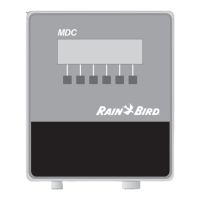
• anextraMDC2Controller,and
• standardtools,suchasscrewdrivers,lineman’spliers,wirestripper,wirenutsandDBYconnectors.




 To Next Page