Troubleshooting, continued
82
Problem One or more field decoders does not always activate the valve.
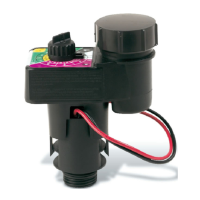
Solution To open a valve, a field decoder supplies the valve with energy (electricity) for a short time.
If the valve’s hydraulic pressure is high, then it needs more energy to open. There are many
factors contributing to the amount of energy available to open a valve. These factors include
the length of the two-wire communications cable to the field decoder and the number of field
decoders operating at one time. The switch code setting controls these factors.
The field decoder’s valve type defines the solenoid’s switch code. The switch code tells the field
decoder how to operate the solenoid. The switch code must be specified correctly for the field
decoder to operate the solenoid. If the solenoids you are using are not made by Rain Bird
®
,
you may need to change the switch code settings. Please see Appendix II: Selecting Electrical
Codes for Solenoids on page 93.
If the two-wire communications cable was installed as a ring cable, a break in the ring can cause
a fault. Because the controller sends the voltage in both directions on the ring, field decoders
can still operate, one at a time, even with a break. However, a break in the ring increases the
cable’s resistance and there may not be enough available energy to open more valves. To
eliminate the fault, you must connect both ends of the ring cable to the L1 and L2 terminals
inside the controller.
Disconnect the ring cable at one end and measure the resistance of both wires from one end
of the cable to the other. If the cable measures 2.5 square millimeters, the resistance should be
about 7.0 Ohms per kilometer of cable.
In other words, if your ring cable measures 6 kilometers, you should be able to measure about
42 Ohms for each wire in the cable. The resistance is inversely proportional to the square. A
cable measuring 3.1 square millimeters will have a resistance of:
7 x 2.5/3.1 = 5.6 Ohms per kilometer.
If the resistance you measure is too high, then the cable is defective. Please see the problem
Finding a break in the two-wire communications cable on page 83.




 To Next Page