Delay of measurement start
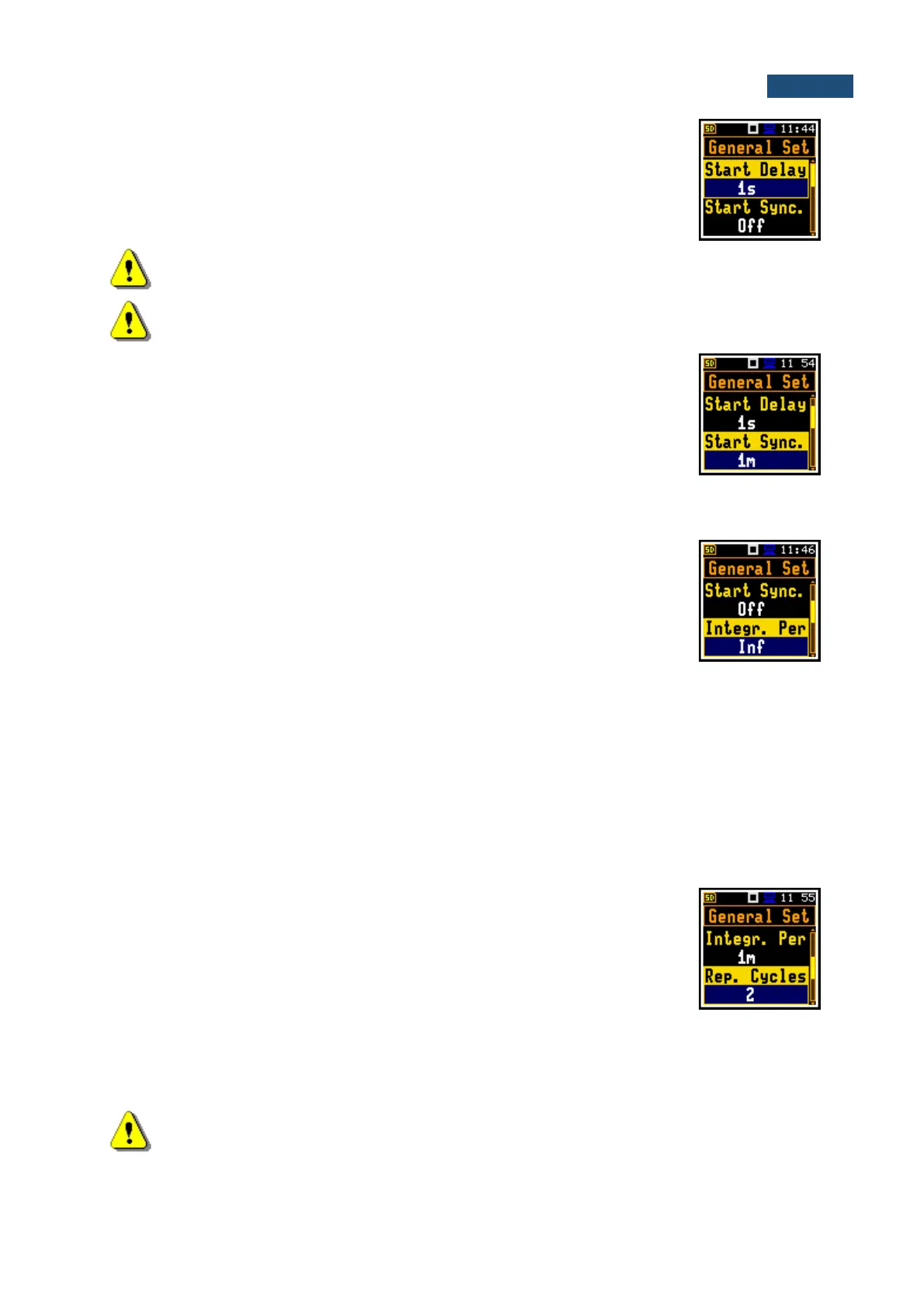
The Start Delay parameter defines the delay period from the <Start/Stop>
keystroke to the real start of the measurement (digital filters of the instrument
constantly analyse the input signal even when the measurements are stopped).
This delay period can be set from 0 second to 60 minutes. Its value by default is
set to 1s.
Note: In the Simple interface mode, the Start Delay parameter is hidden, but the instrument
will use settings previously defined in the Advanced mode or default settings (1s).
Note: The minimum delay period is equal to 0 second. In the Calibration mode, the delay
period is always equal to 3 seconds.
Synchronisation of measurement start
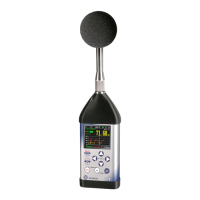
The Start Sync. parameter defines maximum delay period from the <Start/Stop>
keystroke to the start of measurements to allow synchronisation with the
instrument’s RTC. The Start Sync. parameter can be set as: Off, 1m, 15m, 30m
and 1h. For example, if 1h is selected, the measurement will start from the
beginning of the first second of next hour after the <Start/Stop> keystroke, and
then will be repeated also from the first second of the following hour after elapsing
the integration period if the number of cycles is greater than one. The default value
is set to Off.
Integration period
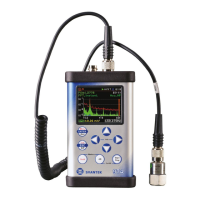
The Integr. Per parameter defines the period during which the signal is being
measured (and for some results averaged/integrated) and measurement results
are logged in the logger file as a Summary Results (see description of the
Logger Setup). The integration period can be infinite (Inf) or selected from the
set: 24h, 8h, 1h, 15m, 5m, 1m, from 1s to 59s with 1s step, from 1m to 59m with
1m step, from 1h to 24h with 1h step.
During the Integration Period, the instrument performs series of 1-second measurements/integrations,
and every second averages 1-second results with the results averaged for n-1 seconds. These averaged
results are displayed and renewed every second for the elapsed measurement time (n seconds). In the
end of the Integration Period the averaged measurement results are saved in the logger file providing
that such saving is switched on.
The measurement will stop automatically after this period and start again if the number of measurement
repetitions (Rep. Cycles) is greater than one.
The definitions of the measurement results in which the integration period is used are given in
Appendix D.
Number of measurement repetitions
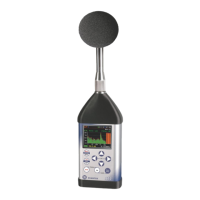
The Rep. Cycles parameter defines the number of measurements (with the
measurement period defined in the Integr. Per) to be performed by the instrument
after the <Start/Stop> keystroke. The Rep. Cycles number values are within the
limits [Inf, 1÷1000]. Its value by default is set to 1.
For example, if Integr. Period is equal to 8 hours and Rep. Cycles is equal to 2, the instrument performs
first integration for the 8-hour period from the measurement start and second integration for the 8-hour
period from the end of the first integration. At the end of each cycle the 8 hours LEQ will be saved in the
file.
Note: In the Simple interface mode, the Rep. Cycles parameter is hidden, but the instrument
will use settings previously defined in the Advanced mode or default settings (1).


 To Next Page