Forward Error Correction in IP Networks 173
ID: um_t2gateway CP560 DVB-T2 Gateway User’s Manual Rev. 2.2 (3686)
Appendix C Forward Error Correction in
IP Networks
The normal operational mode of the public internet is that IP packets are forwarded using a
“best effort” strategy implying that packets may occasionally be lost due to excessive load. To
regulate the transport rate of an IP session a transmitting host will at session start ramp up the
speed until the receiver starts to loose packets. The receiver will send acknowledgments as it
receives packets. In the case of packet loss the source will re-transmit a packet and slow down
transmission rate to a level where packets are no longer lost. This is inherent in the commonly
used protocol TCP (Transmission Control Protocol).
In an IP network for broadcast signals however, this mode of operation becomes impractical
since packet delay from source to receiver resulting from re-transmission amounts to three
times the normal. It is also impractical for multicast as each individual receiver would need to
request retransmissions, which in itself inflicts a bandwidth increase in a channel at the edge of
overflow. Accordingly, all broadcast related IP traffic use UDP (User Datagram Protocol). Here
no retransmission is included, which means that all data must be delivered in a safe manner at
first attempt.
C.1 IP stream distortion
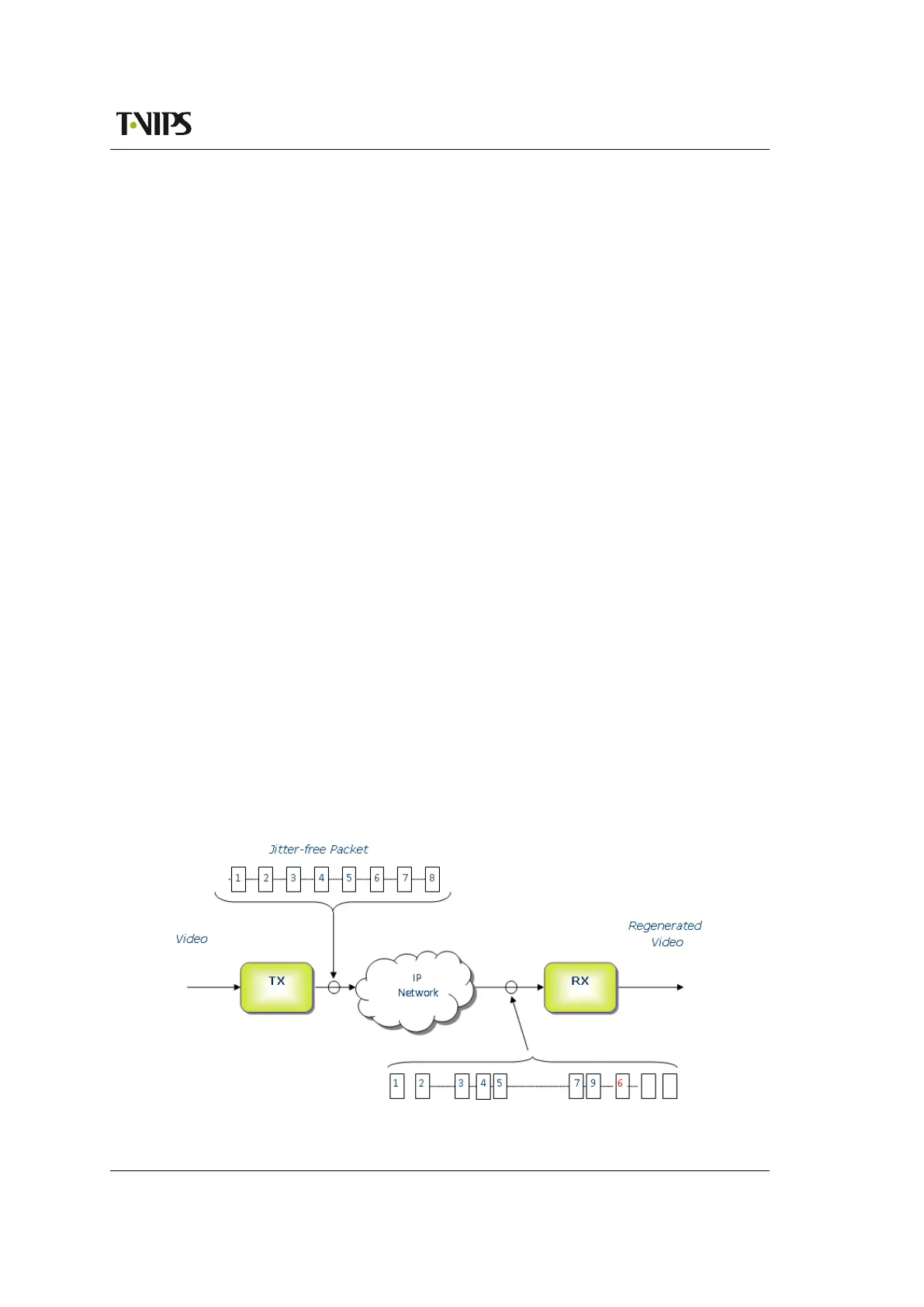
Distortions that influence the performance of an IP video transport system, in addition to packet
loss, are packet delivery time variations (jitter), and packets arriving out of order. It should be
noted that a single bit error occurring within an IP packet will result in the loss of the complete
packet. As IP packets and Ethernet physical link layers normally go hand in hand, IP packets
will be discarded if a single bit error occurs in transmission. The Ethernet link layer is secured
with a cyclic redundancy check (CRC). An Ethernet frame with bit error(s) will be discarded by
the first IP switch or router because the CRC check fails.
Furthermore, multiple packets may be lost during short periods due to congestion. As an IP
packet contains close to 1500 bytes, or about 5% of a video frame for a video stream running at
5 Mbit/s, a lost IP packet will result in visible impairments.
Figure C.1 Impairments of an IP packet stream


 To Next Page