178 Forward Error Correction in IP Networks
CP560 DVB-T2 Gateway User’s Manual Rev. 2.2 (3686) ID: um_t2gateway
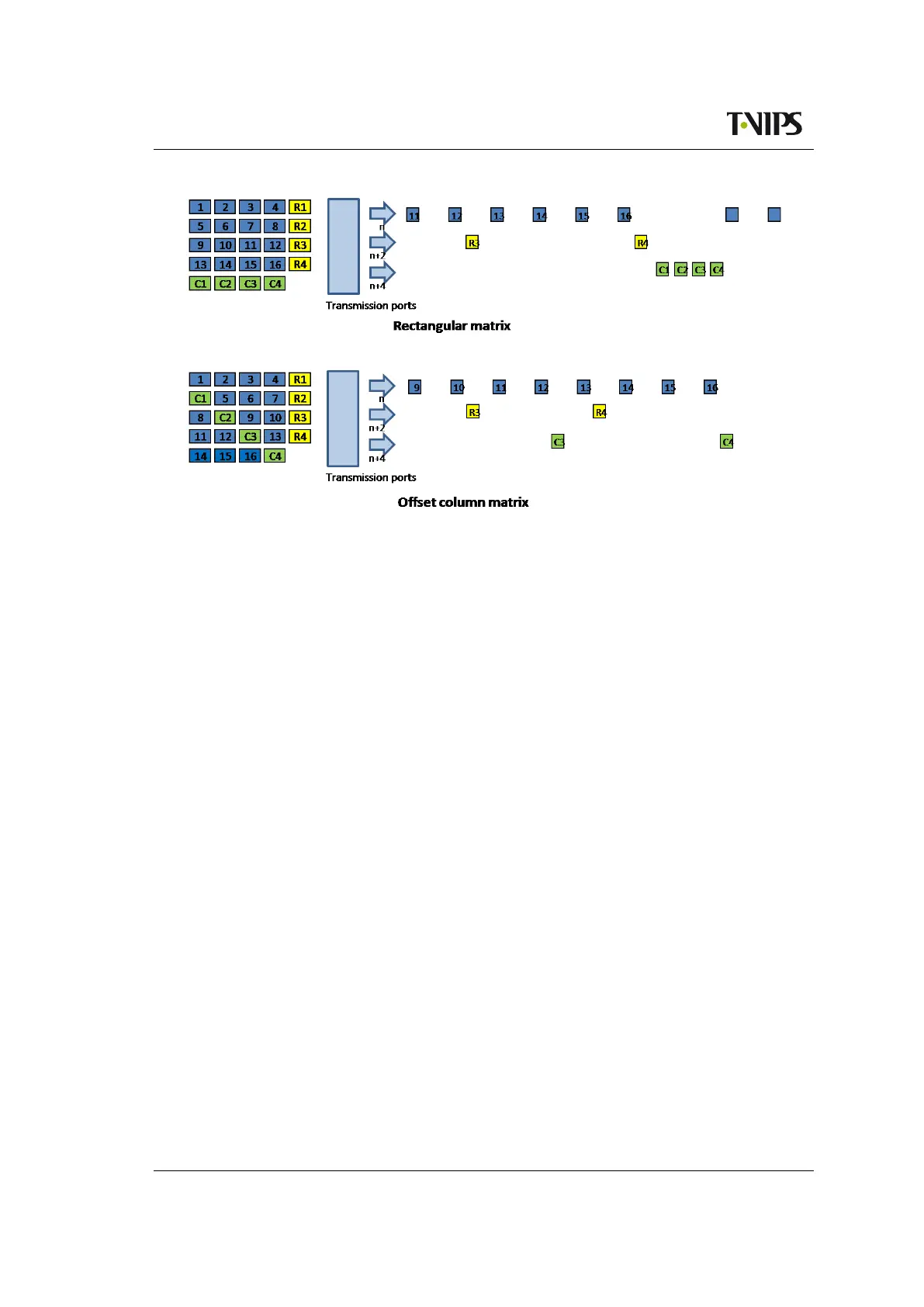
Figure C.7 FEC data transmission
C.5 Quality of service and packet loss in IP networks
One may ask how the FEC strategy relates to an operational IP network. Little information
is available on packet loss patterns. Measurements show that up to 1% of the packets are
duplicates and generated as a result of a retransmission request. Either because the packet has
been lost or it has arrived too late. However, since these results are for TCP connections they
merely serve to indicate an upper level for packet loss rate in an IP/MPLS network. Reported
jitter measurements indicate that 0.01% of the packets were delayed more than 31ms and a
fraction of those packets were delayed more than 100ms. This is also relevant for transmission
of video as out-of-order packets arriving too late will be regarded as lost and must, if possible,
be regenerated by FEC.
There are three main factors that cause packet loss:
• Occasional bit errors in the Ethernet frame caused by low noise margin or equipment
fault
• Buffer overflow or packet delay caused by network congestion
• Packet re-routing, to circumvent a node breakdown or network bottlenecks
Some of the packets will arrive late. IP packet latency will vary as a result of variable traffic
load on the network. Packets that do not arrive in time will be handled as lost packets. The FEC
process will thus be able to handle occasional delay increase for a few packets and maintain a
satisfactory Quality of Service. A video gateway should offer a setting for permissible packet
delay, which should be optimised for the operation. If the receiver buffer latency is increased it
is possible to reduce the FEC overhead and still get an error-free video link.
The Packet Loss Ratio (PLR) for an IP network is not a given number. Performance figures
are normally in the order of 1 x 10
-6
, but occasionally a link may become degraded showing
PLR figures like 3 x 10
-3
. The performance will vary over the day with the lowest performance


 To Next Page