GENERAL
B2420, WSM
G-50
Injection
• When a calcium chloride solution is used, cool it before
pouring it into the tire.
• Do not fill tires with water or solution more than 75 % of full
capacity (to the valve stem level).
• To avoid damage of transmission, do not use rear wheel
weights and liquid ballast at the same time.
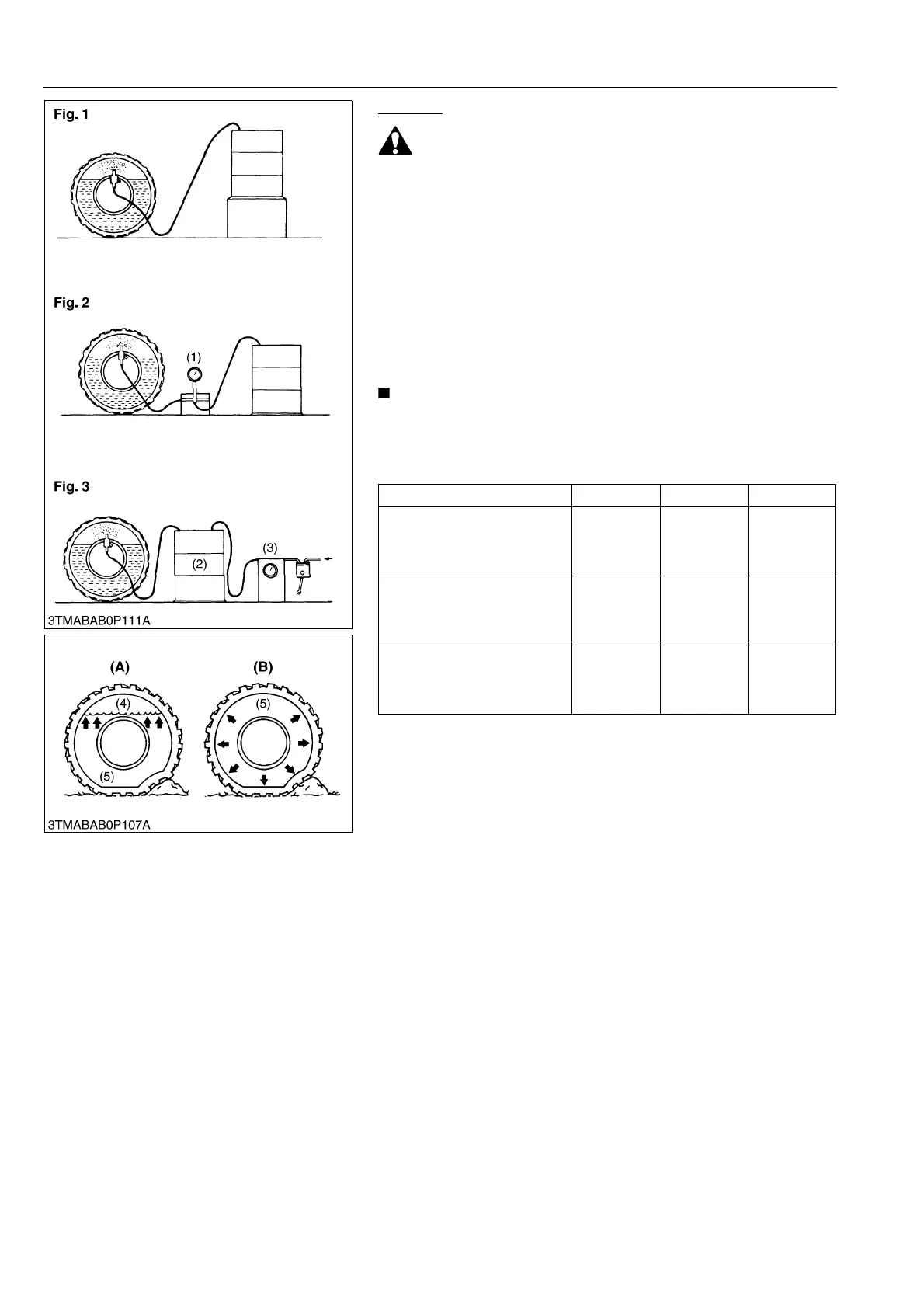
The following four ways can be used to inject water or a calcium
chloride solution into tires.
1. Gravity injection (Fig. 1)
2. Pump injection (Fig. 2)
3. Pressure tank injection (Fig. 3)
4. Injection directly from tap (only when water is being used).
• Once injection is completed, reset the air valve, and pump
air into the tire to the specified pressure.
Weight of calcium chloride solution filling 75 % of full capacity of
a tire.
9Y1210436GEG0027US0
Tire sizes 8-16 9.5-16 9.5-18
Slush free at −10 °C (14 °F)
Solid at −30 °C (−22 °F)
[Approx. 1 kg (2 lbs) CaCl
2
per
4 L (1 gal.) of water]
35 kg
(77 lbs)
54 kg
(119 lbs)
70 kg
(155 lbs)
Slush free at −24 °C (−11 °F)
Solid at −47 °C (−53 °F)
[Approx. 1.5 kg (3.5 lbs) CaCl
2
per 4 L (1 gal.) of water]
37 kg
(82 lbs)
57 kg
(126 lbs)
74 kg
(163 lbs)
Slush free at −47 °C (−53 °F)
Solid at −52 °C (−62 °F)
[Approx. 2.25 kg (5 lbs) CaCl
2
per 4 L (1 gal.) of water]
39 kg
(86 lbs)
60 kg
(132 lbs)
78 kg
(172 lbs)
(1) Pump
(2) Pressure Tank
(3) Compressor
(4) Air
(5) Water
(A) Correct: 75 %
Air Compresses Like A Cushion
(B) Incorrect: 100 %
Full Water Can Not Be
Compressed


 To Next Page