Chapter
9 Electrical
System
.:::2-;,.:B:;:;a::,:t;!:te:;.:r..,:.Y
_____________________________
3.4]H3(B)(C)E
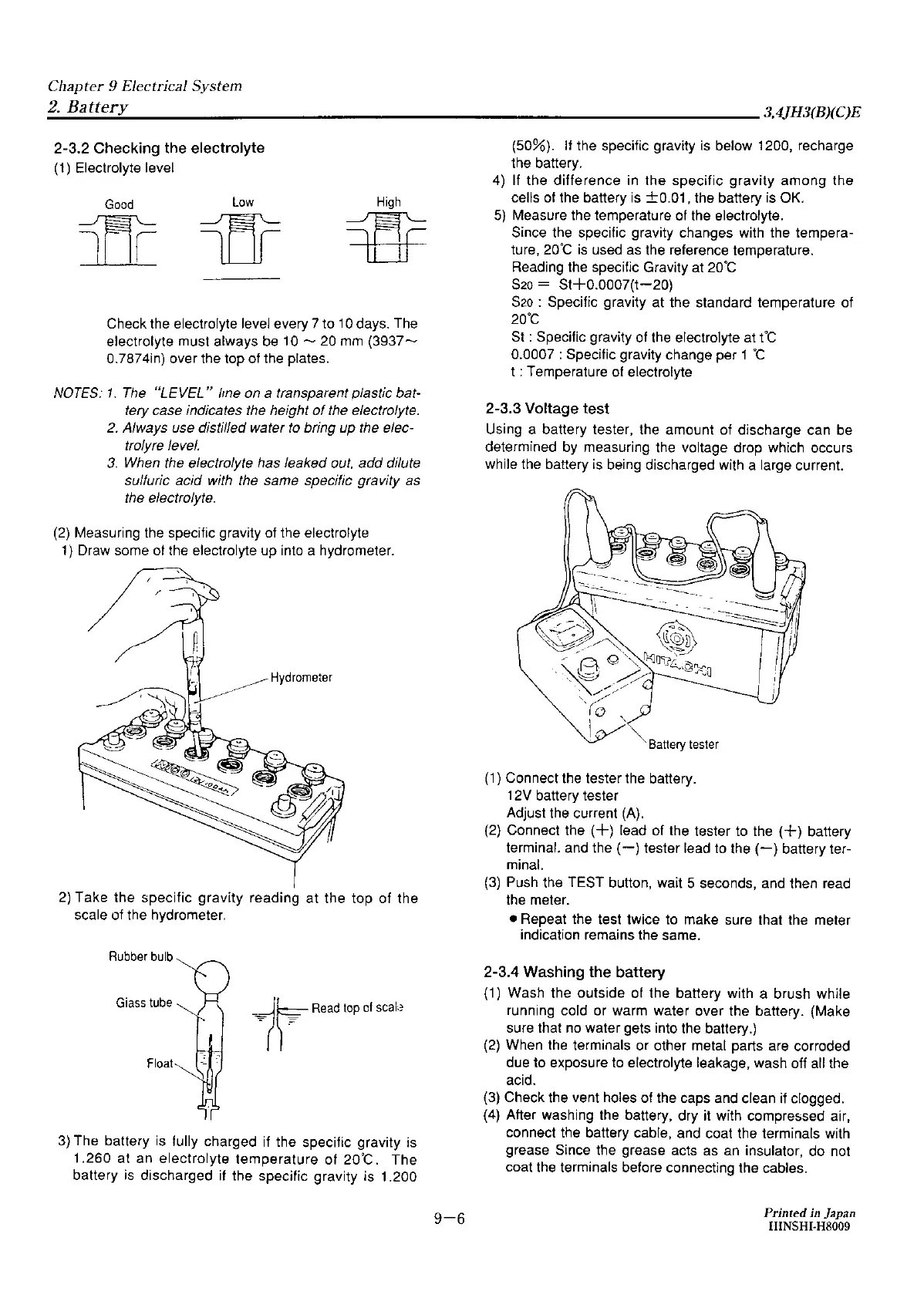
2-3.2 Checking the electrolyte
(1)
Electrolyte level
Good
Low
High
F
Check the electrolyte level every 7 to
10
days. The
electrolyte must always be 10 -
20
mm
(3937-
0.7874in) over the top of the plates.
NOTES:
1.
The
"LEVEL"
line on a transparent olastic bat-
tery case indicates the height
of
the electrolyte.
2.
Always use distilled water
to
bring up the e/ec-
trolyre level.
3.
When the electrolyte has leaked
out,
add dilute
sulfuric acid with the same specific gravity as
the electrolyte.
(2)
Measuring the specific gravity of the electrolyte
1)
Draw some
of
the electrolyte up into a hydrometer.
--
------
Hydrometer
2)
Take the specific gravity reading at the top of the
scale of the hydrometer.
Rubber
bulb~)
""
·~
"(:
~\-'
~··
""
""'
Float~~
3)
The battery
is
fully charged if the specific gravity is
1.260 at an electrolyte temperature of
2o·c.
The
battery
is
discharged if the specific gravity is 1.200
9-6
(50%). If the specific gravity
is
below 1200, recharge
the battery.
4) If the difference in the specific gravity among the
cells of the battery
is
±0.01,
the battery
is
OK.
5)
Measure the temperature
of
the electrolyte.
Since the specific gravity changes with the tempera-
ture, 2o·c
is
used as the reference temperature.
Reading the specific Gravity at 2o·c
S20
= St+O.OOO?(t-20)
S20
: Specific gravity at the standard temperature of
2o·c
St : Specific gravity of the electrolyte at
t°C
0.0007 : Specific gravity change per 1
·c
t:
Temperature of electrolyte
2-3.3 Voltage test
Using a battery tester, the amount of discharge can be
determined by measuring the voltage drop which occurs
while the battery
is
being discharged with a large current.
Battery
tester
(1)
Connect the tester the battery.
12V battery tester
Adjust the current (A).
(2)
Connect the
(+)
lead of the tester to the
(+)
battery
terminal. and
the(-)
tester lead to
the(-)
battery ter-
minal.
(3)
Push the TEST button, wait 5 seconds, and then read
the meter.
• Repeat the test twice to make sure that the meter
indication
remains
the
same.
2-3.4 Washing the battery
(1)
Wash the outside of the battery with a brush while
running cold or warm water over the battery. (Make
sure that no water gets into the battery.)
(2)
When the terminals or other metal parts are corroded
due to exposure to electrolyte leakage, wash off all the
acid.
(3)
Check the vent holes of the caps and clean if clogged.
(4)
After washing the battery, dry it with compressed air,
connect the battery cable, and coat the terminals with
grease Since
the
grease
acts
as
an
insulator,
do
not
coat the terminals before connecting the cables.
Printed
in Japan
IIINSHI-H8009


 To Next Page