Chapter 2 Basic Engine
.;;.4;;..
•
.;:.C,;;.:on.:.:n.:.:e:.:c.:.:ti.:.:n~g..;;R.:.:o;.;;d
.......
_________________________
3_4JH3(B)(C)E
4-2
Crank pin bushing
4-2.1 Checking crank pin bushing
Check for flaking, melting or seizure on the contact sur-
face.
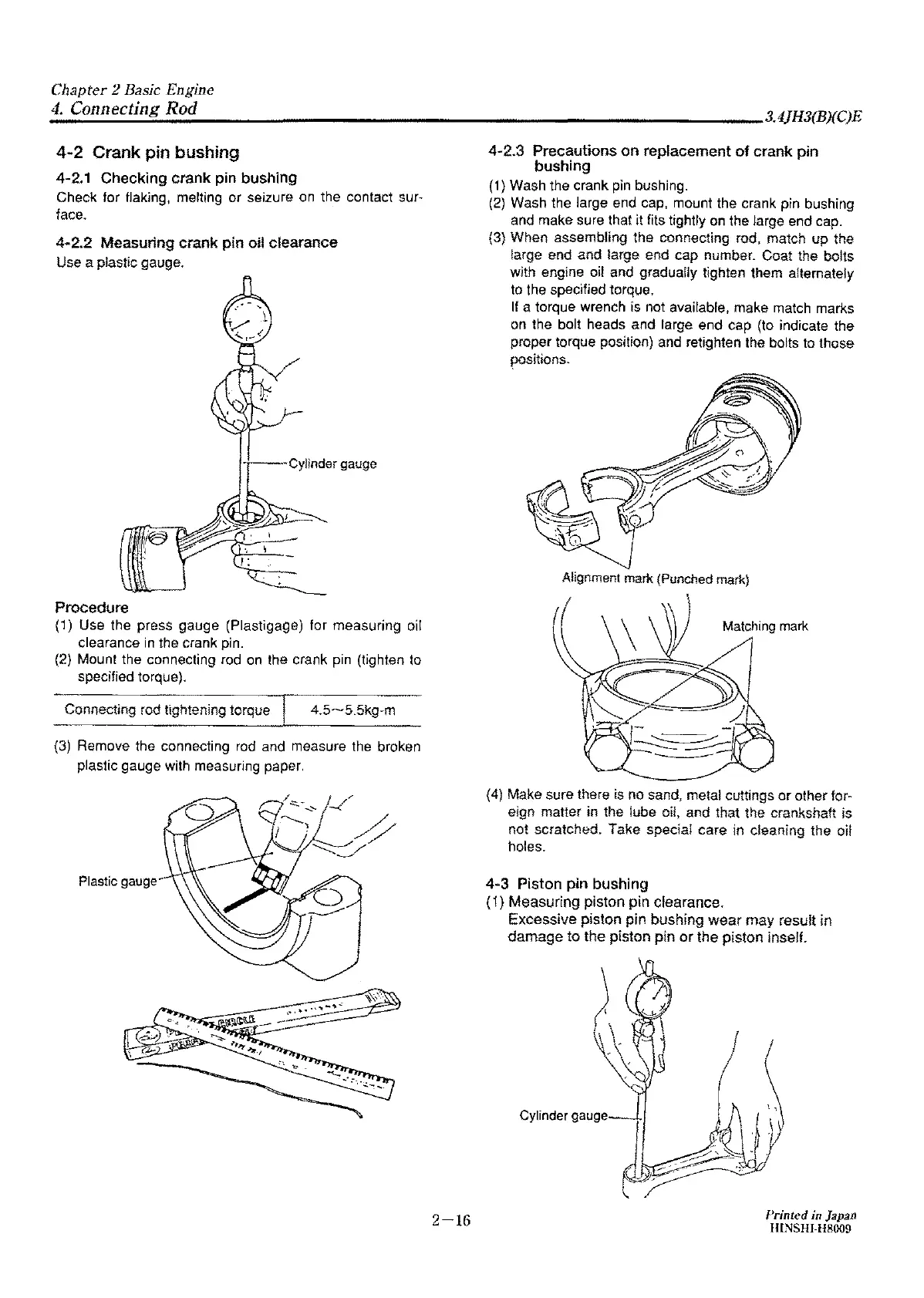
4•2,2 Measuring crank pin oil clearance
Use a plastic gauge.
Procedure
(1) Use the press gauge (Plastigage) for measuring oil
clearance
in
the crank pin.
(2) Mount the connecting rod on the crank pin (tighten to
specified torque).
Connecting rod tightening torque
4.5~5.5kg-m
(3) Remove the connecting rod and measure the broken
plastic gauge
with
measuring paper.
Plastic
gauge
2-16
4-2.3
Precautions on replacement
of
crank pin
bushing
(1) Wash the crank pin bushing.
(2) Wash the large end cap, mount the crank pin bushing
and make sure that it fits tightty on the large end cap.
{3) When assembling
the
connecting rod, match
up
the
large end and large end cap number. Coat the bolts
with engine oi! and graduatly tighten them alternately
to the specified torque.
If
a torque wrench is not available, make match marks
on the bolt heads
and large end cap (to indicate the
proper
torque position) and retighten the bolts to those
positions.
Alignment mark (Punched mark)
Matching
mark
(4) Make sure there is
no
sand, meta! cuttings
or
other for-
eign matter in the lube oil, and that the crankshaft is
not scratched. Take speciaf care in cleaning
the
oil
holes.
4~3
Piston pin bushing
( 1}
Measuring
piston
pin
clearance.
Excessive piston
pin
bushing wear may result in
damage to the piston ptn
or
the piston inself.
Printed in Japan
H[NSHJ.H8009


 To Next Page