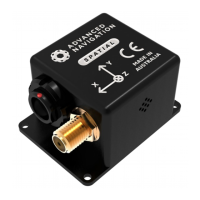
The Boreas D90 is an ultra-high accuracy Digital Fibre Optic Gyroscope (DFOG) GNSS/INS (Global Navigation Satellite System/Inertial Navigation System) designed to provide precise position, velocity, acceleration, and orientation data even in challenging conditions. It combines cutting-edge DFOG technology with closed-loop accelerometers and a dual-antenna RTK GNSS receiver, all integrated through a sophisticated fusion algorithm for reliable navigation and orientation.
Function Description:
The Boreas D90 is a compact and lightweight GNSS/INS system that offers unparalleled accuracy, stability, and reliability due to its DFOG technology. It ensures continuously reliable data even during extended GNSS outages and periods of interference. The system rapidly acquires accurate heading information using its DFOG gyroscopes and an innovative north-seeking algorithm. Advanced Navigation's AI-based sensor filter extracts greater usable information from sensor data. The device is built to be robust, having undergone testing for high safety standards and resistance to shock and vibration, making it suitable for extreme environments. It features multiple interfaces, including Ethernet, CAN, RS232, RS422, and general-purpose IO, and supports industry-standard protocols like NMEA 0183 and NMEA 2000, alongside various proprietary protocols.
Important Technical Specifications:
Navigation Specifications:
- Horizontal Position Accuracy: 1.2 m (0.5 m with SBAS, 0.01 m with RTK or Kinematica Post Processing)
- Vertical Position Accuracy: 2.0 m (0.8 m with SBAS, 0.015 m with RTK or Kinematica Post Processing)
- Accuracy with Odometer/DVL without GNSS: 0.01% of distance travelled
- Velocity Accuracy: 0.005 m/s (0.007 m/s for Trimble BD992 GNSS receiver)
- Roll & Pitch Accuracy: 0.005 ° (0.005 ° with Kinematica post processing)
- Heading Accuracy with Dual GNSS (1.0 m antenna separation): 0.006 °
- Heading Accuracy without GNSS (Secant Latitude RMS): 0.01 °
- Heading Accuracy (Kinematica post processing): 0.006 °
- Gyrocompassing Coarse Alignment: 2 min (typical 10 min for fine alignment)
- Heave Accuracy: 2% or 0.02 m (whichever is greater)
- Rotation Range: Unlimited
- Hot Start Time: 2 s
- Internal Filter Rate: 1000 Hz
- Output Data Rate: 1000 Hz
Dual Antenna Heading Accuracy (based on Antenna Separation):
- 0.5 m: 0.01 °
- 1 m: 0.006 °
- 2 m: 0.005 °
- 5 m: 0.004 °
- 10 m: 0.003 °
Sensor Specifications:
- Accelerometers: Range ± 15 g, Bias Instability 7 ug, Initial Bias < 100 ug, Initial Scaling Error 340 ppm, Scale Factor Stability 100 ppm, Non-linearity 150 ppm, Cross-axis Alignment Error < 0.001 °, Noise Density 30 ug/√Hz, Bandwidth 300 Hz.
- Gyroscopes: Range ± 490 °/s, Bias Instability 0.001 °/hr, Initial Bias < 0.01 °/hr, Initial Scaling Error 80 ppm, Scale Factor Stability 10 ppm, Non-linearity 10 ppm, Cross-axis Alignment Error < 0.001 °, Random Walk 0.001 °/√h ARW, Noise Density 0.06 °/h/√Hz, Bandwidth 400 Hz.
- Pressure: Range 10 to 130 kPa, Bias Instability 8 Pa, Initial Bias < 50 Pa, Noise Density 0.4 Pa/√Hz, Bandwidth 50 Hz.
GNSS Specifications (Aries GNSS Receiver / Trimble BD992 Receiver):
- Supported Navigation Systems: GPS L1, L2; GLONASS L1, L2; Galileo E1, E5b; BeiDou B1, B2 (Trimble also L5, E5a, B3 with license)
- Supported SBAS Systems: WAAS, EGNOS, MSAS, GAGAN, QZSS (Trimble also Omnistar, Trimble RTX with subscription)
- RTCM Input: Version 3.3 / Version 3.2
- Update Rate: Up to 20 Hz / 20 Hz
- Hot Start First Fix: 2 s / 2 s
- Cold Start First Fix: 30 s / 30 s
- Timing Accuracy: 20 ns / 20 ns
- Acceleration Limit: 4 g / 11 g
Hardware Specifications:
- Environmental Protection: MIL-STD-810H, IP67
- Mean Time between Failure (MTBF): > 70,000 hours
- Shock Limit: 50 g 11 ms
- Vibration Limit: 8 g rms 20-2000 Hz random
- Dimensions (height x width x length): 160 mm x 140 mm x 115.5 mm
- Weight: 2.5 kg
- Hot Start Battery Capacity: > 48 hours
- Hot Start Battery Charge Time: 30 minutes
- Hot Start Battery Endurance: > 10 years
- Operating Temperature: -40 °C to 65 °C (v1.0), -40 °C to 75 °C (v1.1 and later)
Communication Specifications:
- Interfaces: Ethernet, RS232/RS422, CAN, 1PPS
- Speed: 100 Mbit Ethernet, 4800 to 4 M baud serial
- Protocols: Advanced Navigation Packet Protocol, NMEA, CANopen
- GPIO Operating Voltage Levels: 5 V, 3.3 V, RS232
Electrical Specifications:
- Operating Voltage: 9 V to 36 V
- Input Protection: -200 V to +200 V
- Power Consumption: 10 W (without GNSS), 12 W (with GNSS), Max 15 W
- Inrush Current: 1.67 A at 12 V, 0.79 A at 24 V
- GNSS Antenna Supply Voltage: 4.5 V to 4.6 V
- Antenna Supply Current: 200 mA
Usage Features:
- Filter Initialisation: Boreas has four levels of filter initialisation: orientation, navigation, heading, and time. Orientation initialisation uses accelerometers to measure gravity, navigation initialisation requires a 3D GNSS fix or external position source, heading initialisation uses dual antenna or gyrocompass, and time initialisation relies on a GNSS fix and 1PPS signal.
- Hot Start Functionality: Allows Boreas to start inertial navigation within 500 ms to 1 s and obtain a GNSS fix in as little as 2 seconds, providing immunity and fast recovery from power failure.
- Time Reference: Provides highly accurate time reference (20 ns with GNSS fix) using a temperature-compensated disciplined oscillator. Offers 1PPS signal, PTP server, and NTP server.
- Heading Sources: Supports North Seeking Gyrocompass, Dual Antenna, Velocity Heading, and External Heading inputs.
- Data Anti-aliasing: Low-pass filters time-dependent data when output rates are lower than 1000 Hz to prevent aliasing.
- Vehicle Profiles: Pre-configured profiles (e.g., Car, Boat, Fixed Wing Plane) impose constraints on the filter to enhance performance.
- Atmospheric Altitude: Internal atmospheric pressure sensor aids altitude estimation. Can be disabled if mounted in an enclosed area or subject to unusual pressure waves.
- Odometer Integration: Improves navigation and orientation during GNSS outages. Supports factory VSS, OBDII interface, aftermarket wheel speed sensors, and radar speed sensors. Automatic pulse length calibration is available.
- Reversing Detection: Algorithm to detect backward vehicle movement, important for correct velocity heading and odometer input.
- Motion Analysis: AI algorithm that associates inertial data patterns with vehicle speed, effective for ground vehicles, especially near stationary conditions.
- RTK Corrections: Supports Network RTK (NTRIP) and Radio Modem RTK corrections for high-accuracy real-time positioning.
- Raw Satellite Data: Outputs raw satellite data for post-processing software (e.g., Kinematica) to achieve high-accuracy kinematic positioning.
- Kinematica Post Processing: Compatible with Advanced Navigation’s post-processing platform for 10 mm accuracy and improved dead reckoning.
- RAIM (Receiver Autonomous Integrity Monitoring): Internal GNSS receiver is equipped with RAIM to detect and exclude faulty satellite signals.
- Heave: Provides vertical heave position at up to four different points on a ship, with a filter that converges in approximately 5 minutes.
- Web User Interface (Web UI): Recommended for configuration and monitoring, accessible via Ethernet, compatible with modern web browsers.
- Boreas Manager: Software tool for logging, testing, display, and configuration, accessible via serial adaptor (x64 architecture only).
- Android App (Spatial Manager): Provides logging and visualisation for Android devices, useful for field testing, connecting via Bluetooth.
- Advanced Navigation Packet Protocol (ANPP): Binary protocol for configuring and monitoring Boreas, with an SDK available for custom applications.
Maintenance Features:
- Firmware Upgrades: Regular firmware updates are released to improve performance and add features. The update function is robust against power loss or file corruption.
- Data Logging: Features an onboard high-capacity data logging system, configurable via the Web UI or Boreas Manager. Log files can be converted to CSV and KML formats for analysis.
- Environmental Protection: IP67 rating ensures protection against dust and temporary submersion when connectors are mated or sealed.
- Cleaning: Connectors should be rinsed or wiped with fresh water if exposed to dirt or dust. The unit should not be subjected to high-pressure jet washing.
- Serial Number Tracking: Serial number label with 2D data matrix barcode on the rear of the enclosure assists in tracking units and provides hardware version and build date.
- Troubleshooting: Boreas Manager and Web UI provide status indicators and communication statistics to diagnose issues. Support is available for complex problems.
- Factory Reset: Option to reset all settings to factory defaults, including clearing hot start data.
- Vibration Mitigation: Designed to tolerate high vibration levels, but recommendations include finding low-vibration mounting points or using vibration isolation mounts for persistent issues.
- Vents: Sophisticated venting system allows air pressure measurement while preventing water ingress. Vents must remain clear of debris and should be gently rinsed with fresh water if blocked.

 Need help?
 General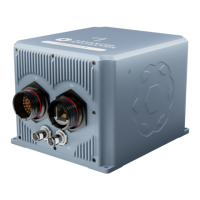

 To Next Page