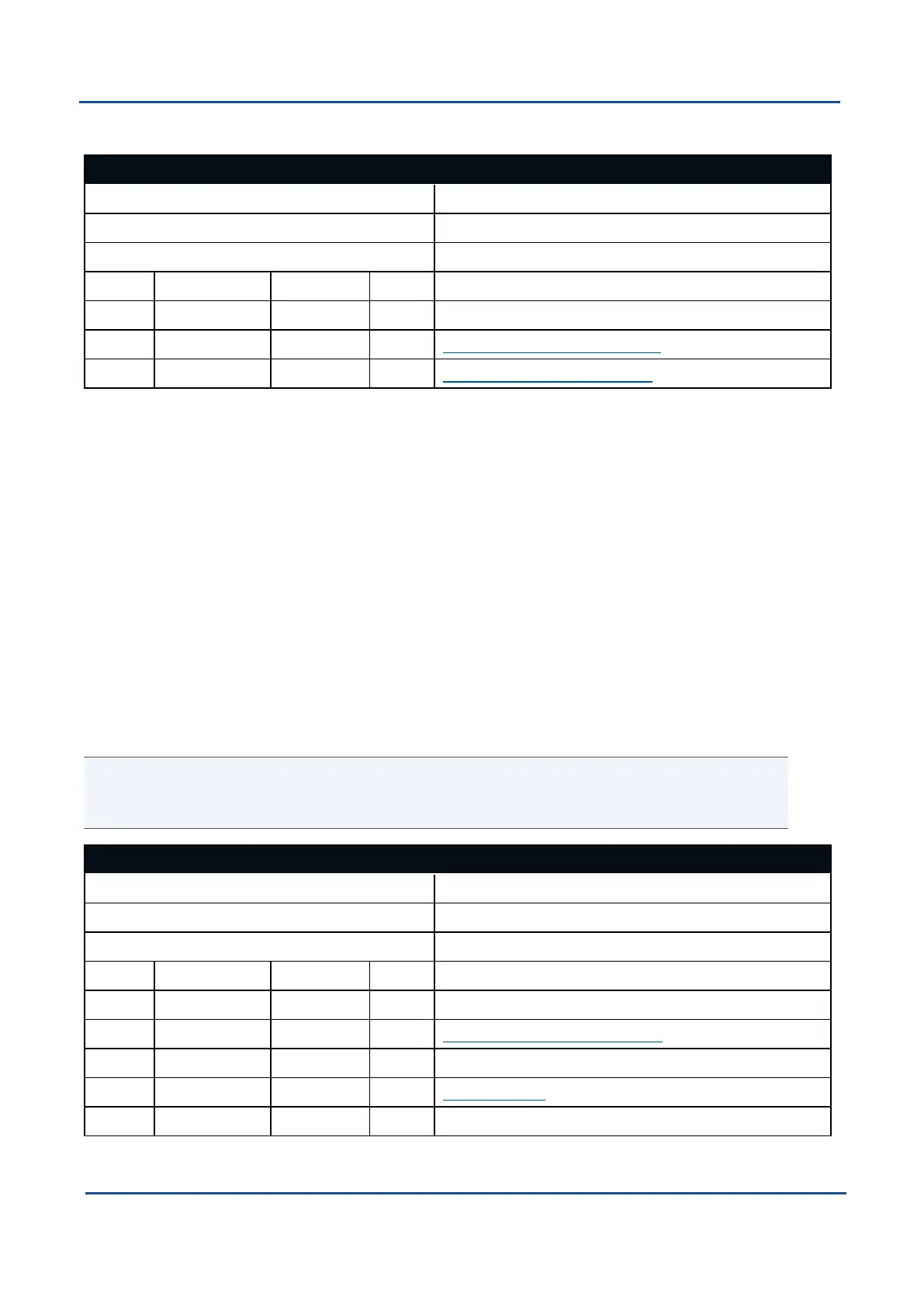
11.5.1 Packet Timer Period Packet
Packet Timer Period Packet
Packet ID 180
Length 4
Read / Write Read / Write
Field # Bytes Offset Data Type Size Description
1 0 u8 1 Permanent
2 1 u8 1 11.5.1.1 UTC Synchronisation
3 2 u16 2 11.5.1.2 Packet Timer Period
Table 129: Packet Timer Period Packet
11.5.1.1 UTC Synchronisation
This is a boolean value that determines whether or not the packet timer is synchronised with UTC time, with
zero for disabled and one for enabled. For UTC Synchronisation to be enabled the packet timer period must
multiply into 1000000 evenly. For example if the packet timer period is 10000 (10 ms), 1000000/10000 = 100
which is valid for UTC synchronisation. If the packet timer period is 15000 (15 ms), 1000000/15000 = 66.6666
which is not valid for UTC synchronisation. To get the rate, use the following formula:
Packet Timer Rate = 1000000/(Packet Timer Period) Hz
11.5.1.2 Packet Timer Period
This is a value in microseconds that sets the master packet timer period. The minimum value is 1000 (1 ms) or
1000 Hz and the maximum value is 65535 (65.535 ms) or 15.30 Hz.
11.5.2 Packets Period Packet
This packet allows the user to configure, add, remove, modify and clear state packets (packets 20 through 180).
Note: This packet will only affect the port from which the packet is sent, leaving the other ports
unaffected. e.g. If you are connected to the Primary serial port, sending this packet will only change the
ANPP output for the Primary serial port.
Packets Period Packet
Packet ID 181
Length 2 + (5 x number of packet periods)
Read / Write Read / Write
Field # Bytes Offset Data Type Size Description
1 0 u8 1 Permanent
2 1 u8 1 Clear Existing Packet Periods
3 2 u8 1 Packet ID
4 3 u32 4 Packet Period
+ Fields 3-4 repeat for additional packet periods
Table 130: Packets Period Packet
v1.2 Page 157 11 Oct 2022
Boreas Reference Manual • Advanced Navigation Packet Protocol


 To Next Page