25
3-5-1-2 CHANGING FREQUENCY USING THE MAIN DIAL
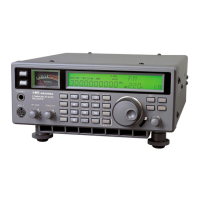
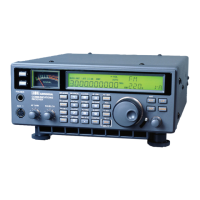
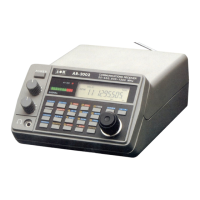
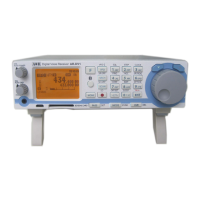
In VFO mode, the active VFO frequency may be ‘tuned’ in using the main dial which is mounted on
the right side of the front panel. Rotate the dial ‘clockwise’ to increase frequency or turn
'counterclockwise’ to decrease frequency.
3-5-1-3 CHANGING FREQUENCY USING [UP] KEY OR [DOWN] KEY
The [UP] and [DOWN] keys provide a convenient method to change the frequency.
The speed the receiver steps up or down depends on the step size which is set to default to auto.
In auto mode, step size, receiver mode etc. are taken from the factory pre-programmed band plan but
may be o verridden at any time.
Press the [UP] key to tune the receiver upward in whichever step size is selected, use the [DOWN] key
to tune the receiver downward in frequency.
3-6 RECEIVE MODE
Due to the necessities of signal bandwidth, channel occupancy and transmission efficiency, different
receive modes are used by various services. The tuning step and receive mode are allocated by
departments of Governments following international discussions so they are not consistent throughout the
world. For this reason, it is necessary to change receive mode in order to monitor various transmissions.
For your convenie nce, receive mode and tuning step size have been pre-programmed into the AR5001D
auto mode band plan data at the factory to simplify the operations of the receiver, especially while you
familiarize yourself with the functions. If needed, the defaults may be manually overridden at anytime
so that you may select an alternative receive mode and tuning step on any frequency.
AM – Amplitude Modulation
Used by broadcast services throughout the world on long wave, medium wave and shortwave.
AM is also used by VHF airband, UHF military airband.
SAM – Synchronous AM
Helps to listen to SW (Shortwave) AM broadcast stations with fading signals.
FM – There are two common types of FM (Frequency Modulation):
NFM – Narrow Band Frequency Modulation
Provides high quality communication for relatively short distance operation.
FM uses a greater frequency bandwidth than other modes.


 To Next Page