SENSseries LB 480 Level measurement
BERTHOLD TECHNOLOGIES GmbH & Co. KG
2 – 237
Volume 2 4 Repair, Maintenance and Upkeep
2
4.5.2 Checking the Crystal-Multiplier Assembly
The plateau becoming too small or too steep indicates faults in the
crystal-multiplier assembly. They can often be detected through
visual inspection. To do this, take the crystal-multiplier assembly
apart. To separate both parts, remove the Mu metal shielding and
carefully detach the crystal from the multiplier window by gently
sliding the crystal sideways. Wipe silicon oil traces off the mating
faces of crystal and multiplier using a soft cloth. While you are doing
this, make sure that the multiplier is not exposed to bright sunlight.
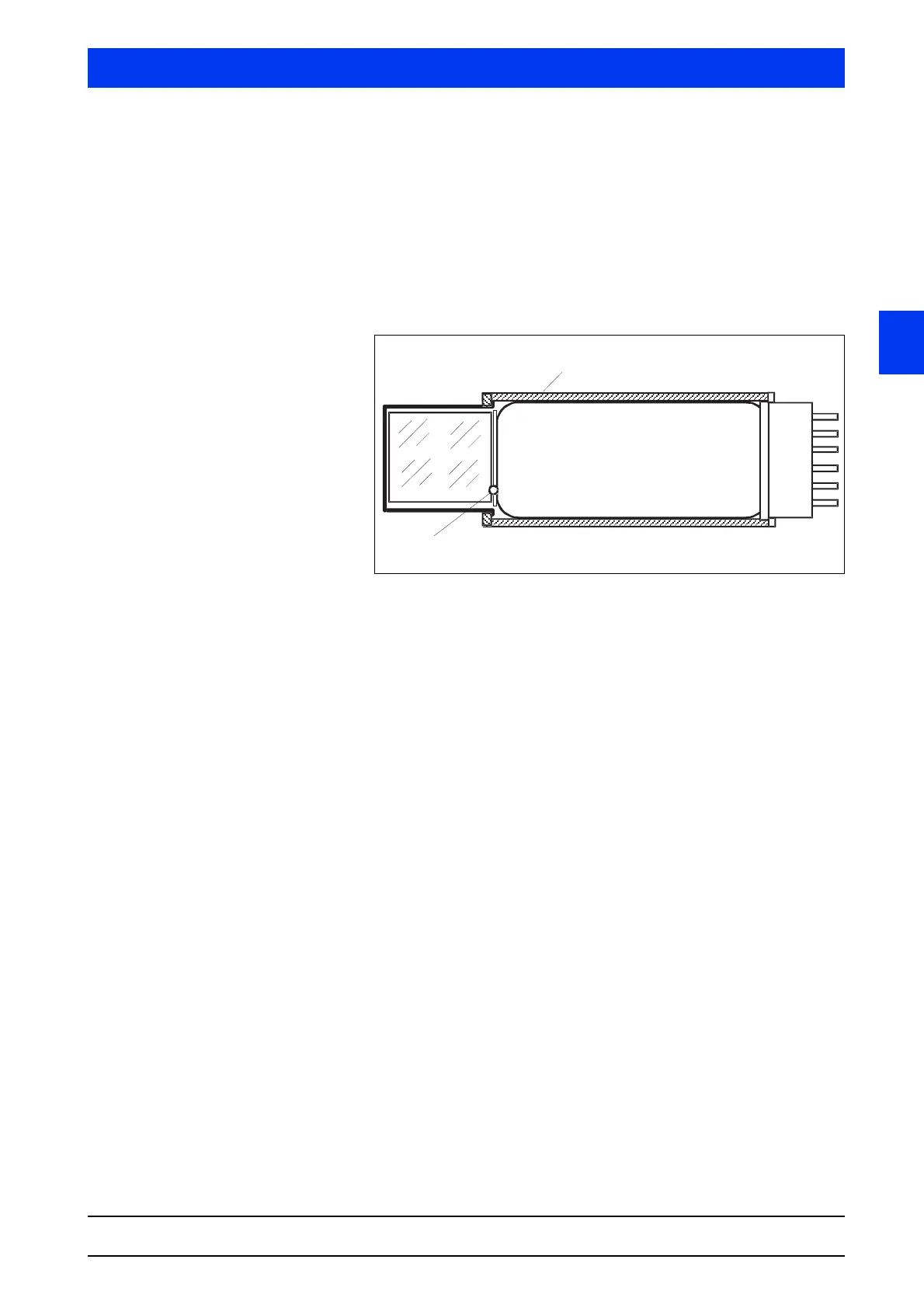
Fig. 4-4 Crystal-multiplier assembly
The crystal must be perfectly clear inside and not show any cracks
or dull areas. The normal coloring is slightly greenish. A yellowish
to brownish coloring is a sign of thermal overload and indicates that
the crystal must be replaced.
The multiplier window is coated with a vapor-deposited layer acting
as photo cathode. This layer gives the window a brownish tint sim-
ilar to smoked glass. If this layer is no longer present or if it is
stained, then the photo-cathode has been destroyed (e.g. by over-
heating, glass breakage, or incident light). The multiplier must be
replaced. Faults caused by damage to the dynode systems (e.g. by
excessive vibration) cannot be identified by appearance. If in doubt,
replace the multiplier.
Before re-assembly, apply a drop of pure silicon oil (Berthold Id.-Nr.
18844) between crystal and multiplier, and distribute it evenly by
gentle rubbing to ensure a sound optical connection between the
two components. Using the adhesive tape, replace the Mu-metal
screen, making sure that it is only under light tension.
Magnetic shielding (Mu metal)
Optical connection
Multiplier
Crystal


 To Next Page