ICEfx™ Cryoablation System
1-1
1 SYSTEM OVERVIEW
WARNING. A thorough understanding of the technical principles, clinical applications,
and risk associated with cryoablation procedures is necessary before using this product.
Use of this device is restricted to use by or under the supervision of physicians trained in
cryoablation procedures with a Galil Medical Cryoablation System.
CAUTION. All new users must be trained on the use of the ICEfx™ Cryoablation System and
cryoablation procedures prior to operating the system. Contact your local Galil Medical representative
to schedule training.
CAUTION. Carefully read all instructions prior to use. Failure to observe all warnings and precautions
may result in complications.
1.1 Brief Description
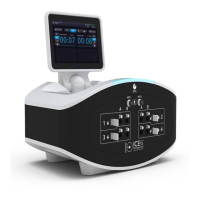
The ICEfx™ Cryoablation System (FPRCH8000) is a portable system intended for cryoablative
tissue destruction using a minimally invasive procedure. The system is computer-controlled with
a touch screen user interface that allows the user to control and monitor the procedure. The
therapy delivered by the system is based on the Joule-Thomson eect displayed by compressed
gases. The Joule-Thomson eect is a change in the temperature of a compressed gas as it ows
through a narrow orice and expands to a lower pressure. Certain gases, such as argon, decrease
in temperature due to the Joule-Thomson eect, while other gases, such as helium, increase in
temperature.
The ICEfx Cryoablation System uses high-pressure argon gas that circulates through closed-tip
cryoablation needles to induce tissue freezing. Freezing is due to the Joule-Thomson eect
augmented by a recuperative heat exchanger within the cryoablation needle. Active tissue thawing
is achieved by controlling the heating element inside CX-type needles to provide active helium-free
thawing (i-Thaw™ or FastThaw™) and track ablation (Cautery).
Cryoablation treatments are delivered by small-diameter cryoablation needles that are inserted into
the target lesion, usually under CT image guidance. When multiple cryoablation needles are placed
into or near the target tissue and freezing is initiated, an iceball grows around the distal end of the
needle shafts. In time, the iceballs coalesce and completely engulf and destroy the target tissue.
The cryoablation needle design and the temperature of the argon gas as well as the freeze duration
determine the size and shape of the iceball. Tissue ablation is achieved by repeated freeze and thaw
cycles with both freezing and thawing contributing to cell death. Each freeze-thaw cycle consists of
a freeze cycle followed by a thaw cycle. Generally, multiple freeze-thaw cycles are used to achieve
complete destruction of the target tissue.
An important benet of cryoablation is that imaging procedures, such as ultrasound and CT, are able
to display the location and size of the iceball. This benet of cryoablation is used for proper control of
the therapy. During use, the procedure must be monitored using image guidance to ensure adequate
tissue coverage and to avoid damage to adjacent structures.
In addition to image guidance, Galil Medical provides temperature sensors to aid in monitoring
tissue temperature near the target site and adjacent critical structures. These temperature sensors
can provide quantitative data to supplement the qualitative information provided by the imaging
modality. Needle temperature display for CX-type needles provides a visual means to monitor needle
performance.


 To Next Page