
 Need help?
Do you have a question about the Codec Tieline Gateway and is the answer not in the manual?
Warning against using the codec during thunderstorms and lightning due to severe injury risks.
Essential safety measures for installation and operation, including electrical shock and fire hazard prevention.
Caution regarding high voltage components inside the instrument, even when disconnected from the power supply.
Explains standard symbols and text conventions used throughout the manual for warnings, cautions, and notes.
Details formatting used for software and hardware elements within the manual.
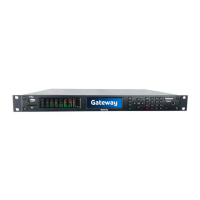
Describes the Tieline Gateway as a powerful DSP-based IP codec for multi-channel audio transport.
Details the Gateway 4 codec, designed for solutions requiring up to 4 audio channels with advanced redundancy.
Explains the function of the four arrow-shaped navigation buttons and the OK button for menu interaction.
Details the specific functions of each operation button on the codec's front panel.
Explains the four arrow-shaped navigation buttons and the OK button for menu interaction.
Details the specific functions of each operation button on the codec's front panel.
Details the supplementary ground terminal for connecting the unit to a ground connection for safety.
Describes the dual redundant AC power supplies that power the codec.
Details the Gigabit RJ-45 ports for AES67 or WheatNet-IP streaming.
Describes the Gigabit RJ-45 ports used for IP connections.
Explains how to adjust the reference scale on PPM meters for optimal audio level display.
Details how to adjust PPM metering options for inputs, outputs, encoders, and decoders.
Steps to globally configure codec inputs and outputs for digital AES3 audio.
Guides on configuring specific inputs and outputs for either Analog or Digital audio sources.
Provides instructions and precautions for safely inserting or removing hardware modules from the codec.
Explains the proprietary session data used by Tieline codecs for connection establishment and management.
Details SIP's role in interoperability and establishing connections between different brands of codecs.
Describes TieLink as a server network for contact management, self-discovery, and NAT traversal.
Step-by-step guide to configuring SIP1 or SIP2 interfaces on the codec.
Instructions for entering SIP account details and registering the account with the SIP server.
Guides on using the HTML5 Toolbox Web-GUI to create new connection programs.
Instructions for loading and establishing connections using programs from the codec front panel.
Instructions on how to open panels and reposition them within the Web-GUI screen.
Discusses layers of security to ensure codec connections remain secure on IP networks.
Guides on changing the default password for the Toolbox Web-GUI for better network security.
Details configuration options for physical Ethernet ports and VLAN interfaces.
Guides on configuring automatic DHCP or manual static IPv4 addresses for the codec.
Instructions for setting up the studio codec as a Fuse-IP server for bonding.
Guides on configuring a remote codec as a Fuse-IP client to establish a bonded connection.
Factors to consider when selecting an audio algorithm, including latency and codec compatibility.
Explains the relationship between jitter buffer settings, latency, and packet loss.
Tips for optimizing jitter buffer settings by establishing connections before going live.
Explains the mechanism of FEC in increasing connection stability by replacing lost data packets.
Discusses the trade-off between FEC quality and bandwidth, and how to configure settings for stable connections.
Guides on configuring program or stream level rules using the Program Manager panel wizard.
Explains how to use the Rules panel for configuring codec level rules related to programs or I/O states.
Instructions for resetting and restoring factory defaults via the HTML5 Toolbox Web-GUI.
Steps for creating backup files of codec configurations onto external media.
Guides on configuring SNMP settings within the codec via the HTML5 Toolbox Web-GUI.
Step-by-step instructions for performing a firmware upgrade using a downloaded file.
Procedures for installing SSL security certificates purchased from a vendor.
Guides on disabling or removing installed SSL security certificates from the codec.
Instructions for enabling or disabling CSRF protection to guard against cross-site request forgery attacks.
Essential steps required for a typical codec installation at the studio.
Explains how to use ping tests to check reachability and packet loss on an IP network.
Describes using traceroute to determine data packet routes and latency to a codec.
FCC Part 15 compliance information regarding digital device operation and potential interference.
Detailed specifications for all input and output interfaces, including RJ45 and AES3.
Information on Gigabit Ethernet ports for AES67 or WheatNet-IP streaming.
Covers configuration and connectivity methods like Web-GUI, CCC, and TieLink.
Detailed pinout diagram and function description for the DB25 control port I/O.
Pinout diagrams and notes for RS232 data connections using DB9 connectors.
Provides pinout diagrams for Gateway 4 DB25 analog and AES3 audio connections.
Details the wiring pinouts for digital AES3 (AES/EBU) connections on the DB-25 connector.
 General
| Brand | Codec |
|---|---|
| Model | Tieline Gateway |
| Category | Conference System |
| Language | English |

 To Next Page
