Viewfi nders and Focusing Screens
VIEWFINDERS FOR DIGITAL IMAGING
Selecting the right viewfi nder and using it properly is as important in digital imaging as it is
in fi lm photography. While the image can be seen on the preview screen of the digital camera
or digital back, you are more likely to evaluate the image in the viewfi nder more carefully
than you do on the screen especially in handheld photography. I therefore recommend using
the viewfi nder for evaluating and focusing the digital image, especially since the Acute Matte
screen on current Hasselblad models provides an extremely sharp image of the subject and
the viewfi nder magnifi es the image for precise focusing. The very sharp and magnifi ed image
on the bright Acute Matte focusing screen is a good reason for selecting Hasselblad for dig-
ital imaging. Viewing through a viewfi nder also assures a steadier camera in handheld work.
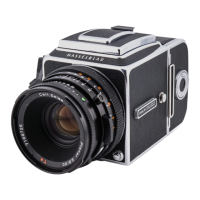
Viewfi nders are interchangeable on the 503 and other more recent V system Hasselblad cam-
era models, so you can select a type that is most satisfactory for your digital imaging or your
fi lm photography.
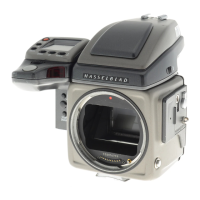
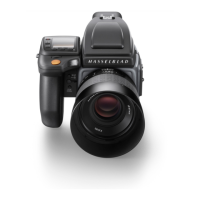
Viewfi nders for Digital Imaging with H Camera Models
All H camera models come with an eye-level viewfi nder that provides convenient viewing
when photographing in the horizontal or vertical format. The original HV 90 fi nder has a
2.7 magnifi cation and shows the full screen area for the 6 4.5 fi lm format. The eye-level
fi nder HVD 90 on the H3D and H3D-II cameras have a higher 3.1 magnifi cation that cov-
ers only the smaller area of the 36.7 49 mm sensor. It has some vignetting at the bottom of
the fi lm format. If you like to see the full area of the fi lm format, you need the HV 90. The
eye-level fi nders have a diopter correction and have a built-in metering system.
Since viewing from the top has advantages in some situations when the H3D camera
models are used on a tripod, a waist-level fi nder with a 3.25 magnifi cation without a meter-
ing system is available as an accessory. The operation of the fi nders is described in detail in
Chapter 4.
7



 To Next Page