254 THE HASSELBLAD MANUAL
and low distortion values. This is the main reason the Superwide camera was produced and is
extensively used for architectural photography.
Because the nodal point from which the focal length is measured is within the physi-
cal dimension of this lens design, these wide angle lenses must be close to the image plane,
something that is possible on the Superwide cameras but not on SLR models.
The Biogon focuses down to 12 in. (0.3 m) and maintains the superb sharpness down
to 12 in., making the Superwide also a superb tool for copying and other critical close-up
photography.
Distagons and the wide angle lenses for the 503 and other V system cameras are retrofo-
cus wide angle designs, sometimes also called inverted telephotos. The nodal point is behind
the physical dimension of the lens, bringing the rear element of the lens far away from the
image plane. Wide angle lenses on SLR cameras must have the retrofocus design as the mirror
must have room to move up and down. As it is somewhat more diffi cult to design retrofocus
lenses for maximum sharpness over a wide range of distances, they are designed to provide
best image quality at long distances. Such lenses are mostly used for long distance photogra-
phy. Distortion values may also be somewhat higher.
Floating Lens Elements
The fl oating element (FLE) lens design improves image quality with retrofocus-type lenses
at closer distances. In an FLE lens, some of the lens elements can be or are moved separately
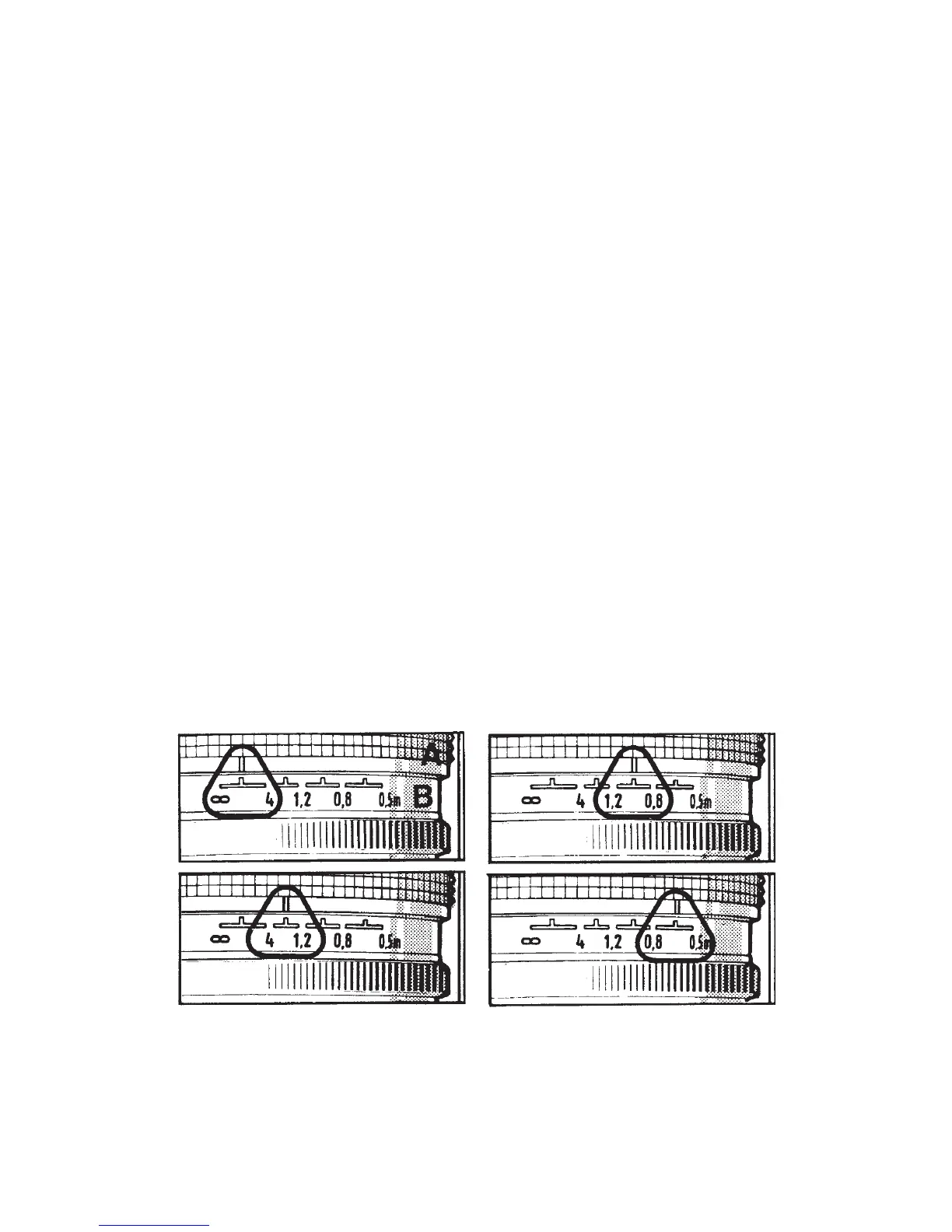
from the rest. In the 40 and 50 mm shutter lenses, you manually move the fl oating elements
using an adjustment ring at the front of the lens (see Figure 14-17). Do not forget to set it
before you take a picture, and always set the front calibration ring fi rst to one of the click
stops based on the subject distance; then focus the image in the normal fashion by turning
Figure 14-17 Operating the FLE. On the 40 and 50 mm CFi (CF) lenses, the FLEs are moved with
the front ring to three or four click stops, which are engraved in meters only. The four settings
on the 50 mm lens are infi nity to 12 feet (4 m); 12 feet (4 m) to 4 feet (1.2 m); 4 feet (1.2 m) to
32 inches (0.8 m); and 32 in. (0.8 m) to 19 in. (0.5 m).



 To Next Page