152 Functions and outputs
HBM QuantumX
Graph for Peak Detection
Measuring
signal
Output
t
V
i
, V
o
HoldRun Run
Funktion
Betriebsart
Peak
Follow
MX878 analog outputs
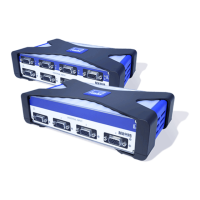
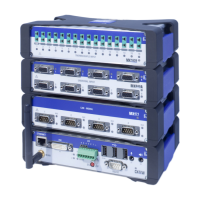
The MX878 is a dedicated module designed for analog output and math channels. In
contrast to other modules, the MX878/MX879 has no analog sensor inputs − instead it
receives data from other modules via the so called ”isochronous FireWire transfer”. The
module then routes this data to an analog output.
You need to connect all modules via FireWire (or use a backplane) for the MX878 to become
operational! Refer to the ”ISO” column in the catman
channel configuration window. This
column indicates if a channel provides its data via the isochronous link (indicated by a
symbol). Click the column or use the column’s context menu to enable or disable
isochronous transfer for a channel.
Providing the data via isochronous transfer may use up significant computing power on the
module (in particular on the MX410 and MX460 high−speed modules). Do not activate the
isochronous transfer needlessly!
MX878 signal generator
The MX878 has eight signal generators. The signals (e.g. set profiles for controlling uni− or
multiaxial actuators) can be individually generated and assigned to analog outputs.
The following signal forms are available (to be defined in an ASCII file):
Constant, sine, rectangle, triangle
Depending on their type, the signal forms are described by the following parameters:
Level, frequency, duty ratio
The signals are buffered and described as follows:
Repetition cycle (continuous, triggered)
Point in time
A buffer that has been filled before can be output with a defined number of repetition cycles,
continuously and triggered, starting at a specific point in time.
In addition, a second buffer is available. While one buffer is output the second buffer can be
filled. Output of the second buffer can be activated immediately or when the first buffer has
been output.
At the end of the sequence, the last output value is held.



 To Next Page