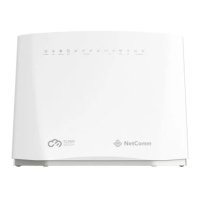
NL1901ACV Enhanced Hybrid 4G LTE Gateway – User Guide
UG01063 v. 1.0 December 2018
*
When the
feature is enabled one of the receive chains
will be turned off to save power.
The current
: (
or
Low Power) will be displayed on
the right.
RX Chain Power Save Quiet
Time
*
When
is enabled, set the number of seconds the
packets per second must be below the value before the
feature activates itself.
*
When
is enabled, set the
to
the maximum number of packets per second that the WLAN interface should
process for during
RX Chain Power Save Quiet Time
before the
feature activates itself.
Allows you to specify the maximum bandwidth of the 802.11g network.
Select the multicast transmission rate in Mbps for the network. The rate of
data transmission should be set depending on the speed of your wireless
network. Available settings are:
,
,
,
,
,
,
,
,
Select Auto to have the Gateway automatically use the fastest possible data
rate and enable the Auto-Fallback feature. Auto-Fallback will negotiate the
best possible connection speed between the Gateway and a wireless client.
The default value is Auto.
Select the basic transmission rate ability for the AP.
Packets that are larger than this threshold are fragmented into multiple
packets.
Increase the fragmentation threshold if you encounter high p
Do not set the threshold too low, since this can result in reduced networking
performance.
The default setting is: 2346
The RTS Threshold is the minimum size in bytes for which the Request to
Send/Clear to Send (RTS/CTS) channel contention mechanism is used. The
gateway sends RTS frames to a particular receiving station and negotiates the
sending of a data frame.
After receiving an RTS, the wireless station responds with a Clear to Send
(CTS) frame to acknowledge the right to begin transmission.
The RTS Threshold value should remain at its default setting (which is the
maximum value):
In a network with significant radio interference or large number of wireless
devices on the same channel, reducing the RTS Threshold might help in
reducing frame loss.
A DTIM (Delivery Traffic Indication Message) is a countdown informing clients
of the next window for listening to broadcast and multicast messages.
Enter a value between 1 and 255 seconds for the DTIM interval between
messages.
A beacon is a packet of information that is sent from a connected device to
all other devices where it announces its availability and readiness.
A beacon interval is the period of time (sent with the beacon) which will
elapse before sending the beacon again.
The beacon interval may be adjusted in milliseconds (ms).
The default (100 ms) is recommended.
Select Enable to turn on this is special frame-bursting accelerating
technology for IEEE802.11g. The default is Enable.




 To Next Page