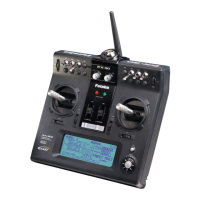
FX-20
6. RC CHARGER, CHARGING THE TRANSMITTER
BATTERY
The RC charger included in the set is suitable for charging 7.4
Volt Lithium batteries, and features a voltage-controlled automa-
tic cut-off circuit (8.4 Volts). The charge current is approximately
2 A.
It can be connected:
• to a 12 V car battery or 12 V DC mains PSU via the car cigar
lighter adaptor (supplied)
• or to a mains socket (110 … 230 V AC) using the mains adap-
tor (also supplied).
Notes on handling and charging the transmitter battery
• Connect the 230 V mains charger to a mains power socket.
• Connect the plug to the 12 V Lithium charger.
• The red monitor LED will now light up.
• Locate the charge lead attached to the 12 V charger, and con-
nect it to the transmitter.
• The charge monitor LED now lights up red to indicate that char-
ging is in progress; the charge current is around 2 Ampere.
• The charge time is around 3.5 hours if the battery is initially
discharged.
• When the charging is nearly finished (90%), the charge control
LED changes to green. The battery can be removed from the
charger and the the process takes approximately 3 1/2 hours
to charge a discharegd battery (No 4846).
• The remaining charge (100%) is complete after a total charge-
time of 5 hours.
Caution:
The battery pack (No. 4846) has an integral Equalizer- and Pro-
tection circuits, which protect the cells from overcharging. To
save energy, the battery should be removed from the charger
after 8 hours.
The battery must only be charged using the RC charger
supplied in the set! Chargers such as the Power Peak Infi-
nity and similar are not suitable, as these devices are desi-
gned for high cell-count packs, and generate a very high
voltage at the cut-off point, which could destroy the protec-
tive battery circuit.
• Li-Poly cells feature an extremely low self-discharge rate of
around 0.2% per day, and for this reason they can be stored
for long periods without problems. However, deep discharging
must be avoided, as the pack will sustain permanent damage
in the form of loss of capacity if discharged too far (the pro-
tective electronic circuit avoids this). After about five months
of storage - but at the latest when the pack voltage falls to 2.5
Volts / cell - it is essential to recharge the pack. Before any
protracted period of storage you should recharge the battery
to at least 50% of nominal capacity. After about five months
the pack should be recharged again.
14


 To Next Page