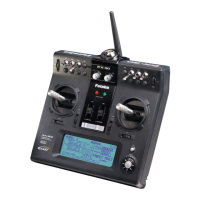
FX-20
2.2 R-6108 SB RECEIVER
Full range 8/18-channel 2.4 GHz FASST receiver, slimline and
lightweight for models with narrow fuselage/hull. With a serial
bus (S-BUS) - system for up to 18 channels and so perfect for
large scale model aircraft. Outputs 1...8 can have 8 traditional
analogue or digital servos attached. The R 6108SB receiver
has a switch to select between digital and analogue servos.
This makes the signal pulse for digital servos at the outputs 1-6
even faster, resulting in even shorter response time.
New: S-BUS output
Up to 18 of the new, programmable S-BUS servos or other
S-BUS components such as battery switch PSS2018, HC-3
Xtreme, gyro GY 520, etc. can be connected in series to this
output. Using digital addressing, the servo will only react to
information which has the correct servo address.
Compatible with 2.4 GHz FASST RF modules TM-8, TM-10,
TM-14 and FASST transmitters from 8 channel upwards
and in Multi mode.
2.3 Receiver binding
General advice about 2,4 GHz Radio-control systems
The 2,4 GHz System operates differently to previous radios
that work in the 27-40 MHz frequency band.
• The radiation of 2,4 GHz signals works in a straight line and
therefore it is vital to maintain line of sight contact with the
model.
• Large obstructions between Tx and Rx can reduce or block
the signal.
• Close to the ground, the Tx signal is weaker than with 27-40
MHz radios.
• On misty days or wet ground can reduce the ground range
considerably.
• If the model is close to the ground and there is an obstruc-
tion such as (person, vehicle, object etc.) between the Tx
and Rx, than the range can be much reduced.
BINDING (EASY-LINK)
Pressing the “Easy-Link” button, automatically stores the
unique code number of the Tx (130 Million codes). The receiver
only will respond to the signal of the specific transmitter with
this “Binding” process.
RECEIVER STATUS LED INDICATION (R6008HS)
• During binding, no other FASST System should be operated
nearby.
• Place the transmitter and receiver close together (approx.
50cm or closer)
• Switch on Tx
• Switch on Rx power supply
• Hold the Easy Link
button (ID Set) on the
receiver for at least 1
second and release
again to “bind” the
receiver to the transmit-
ter.
• When the binding has taken place, the Rx LED illumina-
tes green. This fixed coupling of the transmitter to receiver
offers the best conditions for an improved suppression of
interference compared to traditional systems. Whereas, a
digital filter can only filter out the control impulse of the asso-
ciated transmitter, in this way interference and influences
from other transmitter are very effectively suppressed.
• It is possible to “bind” several receivers to the same
transmitter. Should the “binding” of other transmitters be
required, by simply pressing the Easy-Link button after swit-
ching on the power will re-bind the receiver to a new trans-
mitter.
ICONVERTING FROM ANALOGUE TO DIGITAL SERVOS
The factory setting is set to “Normal” mode and suits the com-
monly used Analogue servos. To achieve a quicker reaction on
channels 1-6, which leads to a further improved reaction time
when using Digital Servos, use the following method. Setting
of the digital mode:
1. Switch off the receiver after “binding”.
2. During the switching on of the Rx, press the Link/Mode but-
ton for 2-3 seconds, The red and green LEDs will flash.
3. Release the Link/Mode button. The monitor LED turns
green.
4. Switch the receiver off, so that the settings are stored.
Converting back from digital to analogue mode functions in the
same principle. The monitor LED flashes red and green to in-
dicate the switch-over to analogue mode when pressing the
Link/Mode button. On releasing the button, the red LED will
be illuminated.
Legend:
LED red: = Analogue mode
LED orange: = Digital mode
Note:
Channels 1-6 operate in digital mode, channels 7+8 always
operate in analogue mode. The analogue-digital changeo-
ver also affects the S-BUS output, which is automativally
processed by S-BUS and digital servos.
Analogue mode must be selected if analogue servos are
to be operated at the S-BUS output via a PWM adapter.
Otherwise the higher frequency will be irreparably dama-
ged the analogue servos! Double-check every new setting
on your receiver!
Take care that during this process athat no other FASST
transmitters are switched on in the local vicinity.
5
General
LED green LED red Status
Off Solid
No signal reception
Solid Off
Receiving signals
Flashing Off
Receiving signals but ID
is unmatched
Alternate flash Unknown problem
Key “ EASY LINK” LED


 To Next Page