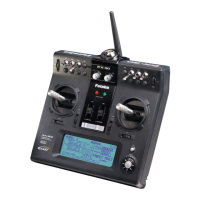
FX-20
FX-20
CONTENTS PAGE
13.2 Pitch curve settings .............................................. 53
13.3 Throttle curve settings .......................................... 55
13.4 THR hold/ Autorotation settings ............................ 56
13.5 Swash mixer ......................................................... 56
13.6 Throttle mix ........................................................... 57
13.7 Pitch -> Rud (Revo) mix ....................................... 57
13.8 Gyro settings ........................................................ 57
13.9 Governor settings ................................................. 58
13.10 Fuel mixture settings ............................................ 59
14. Programming example for FX-20 Tx
example 4 flapped glider wing........................... 60
15. Tx software update ............................................. 82
16. Installation and aerial positioning of
2,4 GHz FASST Rx .............................................. 83
16.1 Power Down mode range testing .......................... 84
16.2 Switch harness ..................................................... 85
16.3 Servo leads ........................................................... 85
16.4 Interference suppression filter .............................. 85
16.5 Servo installation .................................................. 85
16.6 Servo travel and arms .......................................... 86
16.7 Linkage installation ............................................... 86
17. Operational advice ............................................. 86
17.1 Switch on sequence ............................................. 86
17.2 Metal to metal interference ................................... 86
17.3 Brushed electric motors ........................................ 86
17.4 Electronic ignitions ................................................ 87
17.5 Rx battery capacity/operating time ....................... 87
18. Guarantee ............................................................ 87
19. Liability exclusions ............................................. 87
20. Homologation ...................................................... 87
21. Declaration of conformity .................................. 87
22. Compliance Information Statement .................. 88
23. Accessories ........................................................ 89
24. Service addresses .............................................. 91
25. End of life disposal ............................................. 92
Safety Notes, observe at all times
Please take the trouble to read right through these instruc-
tions before attempting to use the equipment for the first time,
paying particular attention to the Safety Notes. If you are a
beginner to radio-controlled model aircraft or helicopters, we
recommend that you ask an experienced modeller for help, as
you are bound to need support and advice initially.
This radio control system is designed and approved exclusi-
vely for use with radio-controlled models. If you use the equip-
ment for any other purpose, Robbe Modellsport will accept no
liability for the consequences.
SAFETY NOTES
Radio-controlled models are not toys or playthings in the usual
meaning of the term, and young people should not operate
them under fourteen years of age unless an experienced adult
is available to supervise them. Building and operating these
models requires technical expertise, manual skills, a cautious
attitude and safety-conscious behaviour. Errors, negligence
and omissions in building or flying these models can result in
serious personal injury and damage to property.
The manufacturer and vendor of the equipment have no
means of checking that your models are built and operated
correctly, and for this reason we can do no more than bring
these hazards expressly to your attention. We deny all further
liability.
Technical faults, whether electrical or mechanical, can result
in electric motors bursting into life unexpectedly, causing other
parts to come loose and fly around at high speed. Switching
on the receiving system when the transmitter is not active can
also have the same effect.
In either case there is a serious risk of injury. Propellers,
helicopter rotors and all other rotating objects, which are
driven by motors or engines, represent a constant hazard
and a potential source of injury. Avoid touching such
parts at all costs. It is a sobering thought that a propeller
revolving at high speed could cut off your finger.
Do not stand in or close to the primary danger area around the
propeller or other rotating parts whenever the electric motor
is connected to a drive battery. Take care to keep all other
objects from making contact with revolving parts. Protect your
radio control system from heat, dust, dirt and damp, and do
not subject your equipment to excessive heat, cold or vibra-
tion. Radio control systems should only be used in “normal”
conditions, i.e. within a temperature range of -15°C to +55°C.
Use only the recommended battery chargers, and super-
vise the procedure when charging batteries. Please read
and observe our safety notes regarding charging the bat-
teries. Overcharging, or incorrect charging methods can
result in the batteries exploding or bursting into flames.
Always maintain correct polarity.
Avoid subjecting this equipment to undue shock or pressure.
Check your system regularly for damage to cases and wiring.
If a unit gets wet or is damaged in a crash, it should not be
used again even after you have dried it out and checked it tho-
roughly. The only safe course of action is to replace damaged
items, or at least have them checked by the robbe Service.
Faults caused by damp or crash-induced shock may not be
obvious to the layman, but after a short period of further use
they may cause catastrophic failure. It is important to use only
the components and accessories which we expressly recom-
mend, and always use genuine robbe-Futaba connectors. It
is not permissible to make modifications of any kind to the
system components.
Note:
2,4 GHz FASST technology can be used for all model- air-
craft and surface- (marine and vehicle) models.
ROUTINE PRE-FLIGHT CHECKS
• Always extend the transmitter aerial fully before operating
your model, and check that it is firmly engaged in its socket.
• Ensure that the throttle stick is at the stop / idle end-point
before you switch the receiver on.
• Always switch the transmitter on first, then the receiver.
• Always switch the receiver off first, then the transmitter.
• Carry out a range check before the flight or run.
• Have you selected the correct model memory?
• Check all the working systems. Ensure that the control sur-
faces respond to the stick commands in the correct “sense”
(right stick = right rudder etc.), and that the travels are as
recommended.
• Are all the mixer functions and switches set correctly?
• Are the batteries sufficiently charged?
• If you are not sure of any point - don’t fly, as this would
endanger yourself and anybody else at the site.
OPERATING THE MODEL
• Never fly over spectators or other pilots.
3
Safety notes


 To Next Page