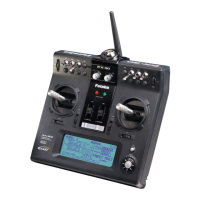
FX-20
2.4 CONNECTING THE SERVOS USING PWM
Connecting the servos and power supply:
R6108 SB 2,4GHz receiver (Rx)
Outputs 1...7: 1 ... 8 Proportinal channels for Servos.
Connection: B = Receiver battery / channel 8
The switched putputs DG1+DG2 are accessible on the 8 chan-
nel R-6108 SB receiver only via the S-BUS outputs (channel
9+10).
Note:
Connecting a large number of powerful or digital servos, the
continuous current rating (3A) of the supplied switch harness
will be insufficient. It will be necessary to use an appropriate
high current power supply (the so-called battery backer) for
the receiver and servos. Your dealer will be able to advise on
suitable equipment
S-BUS CHANNEL ALLOCATION
In contrast to standard servos, where the receiver has a single
PWM pulse per servo channel, S-BUS systems no longer have
classic individual servo channel alloocations.
Information relating to how far and in which direction the servo
is to run is digitally coded, similar to the PCM system for trans-
mitters. The pulse telegram additionally contains the direction
and travel of all 18 servo channels as well as the channel
address. Each servo is allocated a channel number and it se-
lectes the channel number as well as the travel and direction
information from the pulse telegram. It responds only to com-
mands that contain the correct channel number. This digital
filter increases the servos‘ immunity to interference.
The allocation of the S-BUS channel number can be ade in
one of three ways:
1.
A channel number can be allocated to the servos also via the
receiver. Use the following procedure:
1. Plug servo jumper into „DATA“ socket at the receiver.
2. Switch on receiver.
3. The set mode is indicated by flash sequences
Mode A: red LED flashes 3 times
Mode B: green LED flashes 3 times
4. To change the mode, press and hold the „LINK“ button for
about 2 seconds. Changing the mode the red and green
LEDs will flash. releasing the „LINK“ button, the new mode
setting will be displayed.
5. Switch off receiver and unplug servo jumper.
The servos can now be connected to the S-BUS output of the
receiver via the S-BUS hub or V-lead. Check functions before
starting up!
2.
The handy SBC-1 Programmer No. F1696 which can also be
used to allocate channels to the S-BUS servos and S-BUS
PWM adapters is recommended on the flying field.
3.
Servo addressing can be carried out with the PC-LINK program
which can be downloaded free of charge in the download sec-
tion on the robbe homepage.
With this program you can additionally program functions such
as servo mid-point adjustment, end-point adjustment, servo
speed, start-off characteristics, etc. individually for each servo.
Note:
The USB adapter CIU-2 No. F1405 is required to program
the servos and allocate the channel number via a PC.
6
General
Channel
1 ... 8
B = Connection
Receiver Battery
Monitor LED
Receiver
Battery
8
1
2
3
4
5
6
7
Plug servo jumper
Output
Channel
Mode A Mode B
1 1 9
2 2 10
3 3 11
4 4 12
5 5 13
6 6 14
7 7 15
8 8 16


 To Next Page