Tsunami Mode-Locked Ti:sapphire Laser
7-2
confident that this is the case, remove the cover for inspection. If they
are dirty, refer to Chapter 9 for information on cleaning optics.
4. Turn on the chiller according to its instruction manual and verify its
temperature is set for 18°C (64°F).
5. Begin the dry nitrogen purge.
The Model 3910 regulator/filter purge unit is provided for use with
bottled nitrogen gas to eliminate problems associated with dust, con-
tamination and the tuning discontinuities caused by oxygen and water
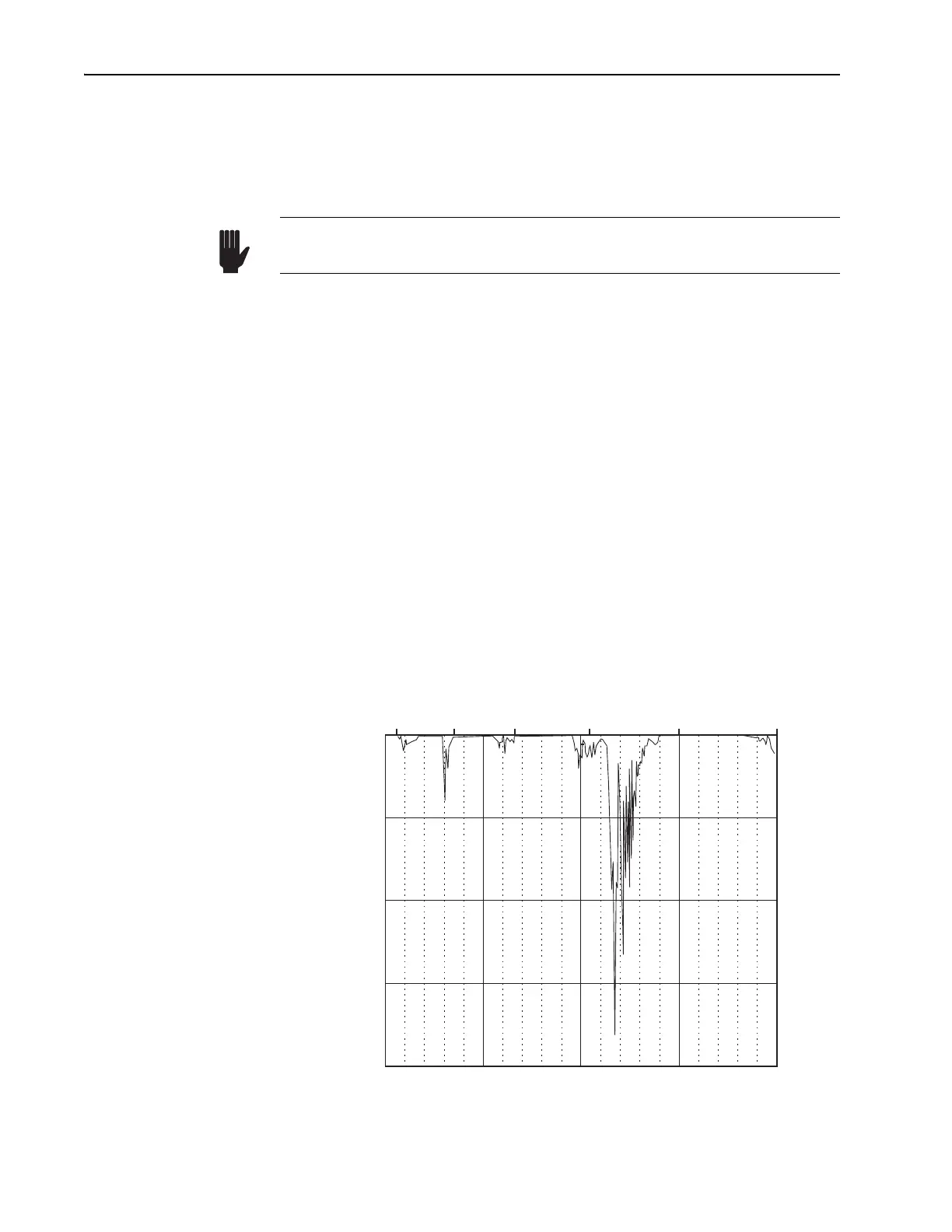
vapor. The latter exhibits strong absorption lines in the long wave-
length region between 840–1000 nm, especially at 944, 950, 981.2
and 984.1 nm (Figure 7-1). Due to the strength of these absorption
lines, the moisture level within the laser head must be below 1000 ppm
to allow problem-free modelocking. For these wavelengths, we recom-
mend using 99.999% pure, dry, oil-free, Electronic Grade 5 nitrogen at
a starting purge rate of 0.3 m
3
/hr (10 SCFH) for at least 1.5 hours with
the purge bleed valve open. Then reduce it to 0.17 m
3
/hr (6 SCFH) with
the purge valve closed to maintain positive pressure within the system
during system use.
a. Verify the laser head cover is in place and clamped down, sealing
the cavity.
b. Verify the nitrogen tank output regulator is set to minimum, then
turn on the nitrogen supply.
Figure 7-1: Transmittance vs. Wavelength for Oxygen and Water Vapor.
Setting the chiller pressure higher than 275 kPa (40 psi) can lead to cat-
astrophic damage and will void the warranty.
Warning!
1.00
0.99
0.98
0.97
700 800 900 1000 1100
Wavelength (nm)
Wave Number (cm )
-1
13000 12000 11000 1000014000
Transmittance


 To Next Page