8-1
Chapter 8 Lok-to-Clock Electronics
Note: you must have a Model 3960C, 3950C or 3941C version Tsunami
®
laser head to use the Lok-to-Clock
®
(LTC) system.
Functional Overview
The optional Model 3930 Lok-to-Clock electronics module provides phase-
locked loop (PLL) stabilization of Tsunami output pulses. It allows you to
precisely synchronize those output pulses to either the internal 80 MHz ref-
erence source or to an external one, such as an rf synthesizer or to another
mode-locked laser. The LTC system is capable of reducing timing jitter to
< 0.5 ps when pumped by a Millennia
®
laser.
The phase (timing) of the output pulse train (as monitored on a photo
diode) is compared to the phase of a stable reference oscillator. Any phase
difference (where a phase difference of 360° or 2π corresponds to a timing
error of about 12 ns) is converted to an error voltage. This error signal is fil-
tered, amplified, and used to drive a piezo-electric transducer (PZT) that is
mounted on intracavity mirror M
4
. The mirror movement changes the cavity
length of the Tsunami laser and modifies the pulse repetition rate to mini-
mize the phase difference. When the pulses are perfectly overlapped, there
is no phase error and the cavity length and pulse repetition rate are held
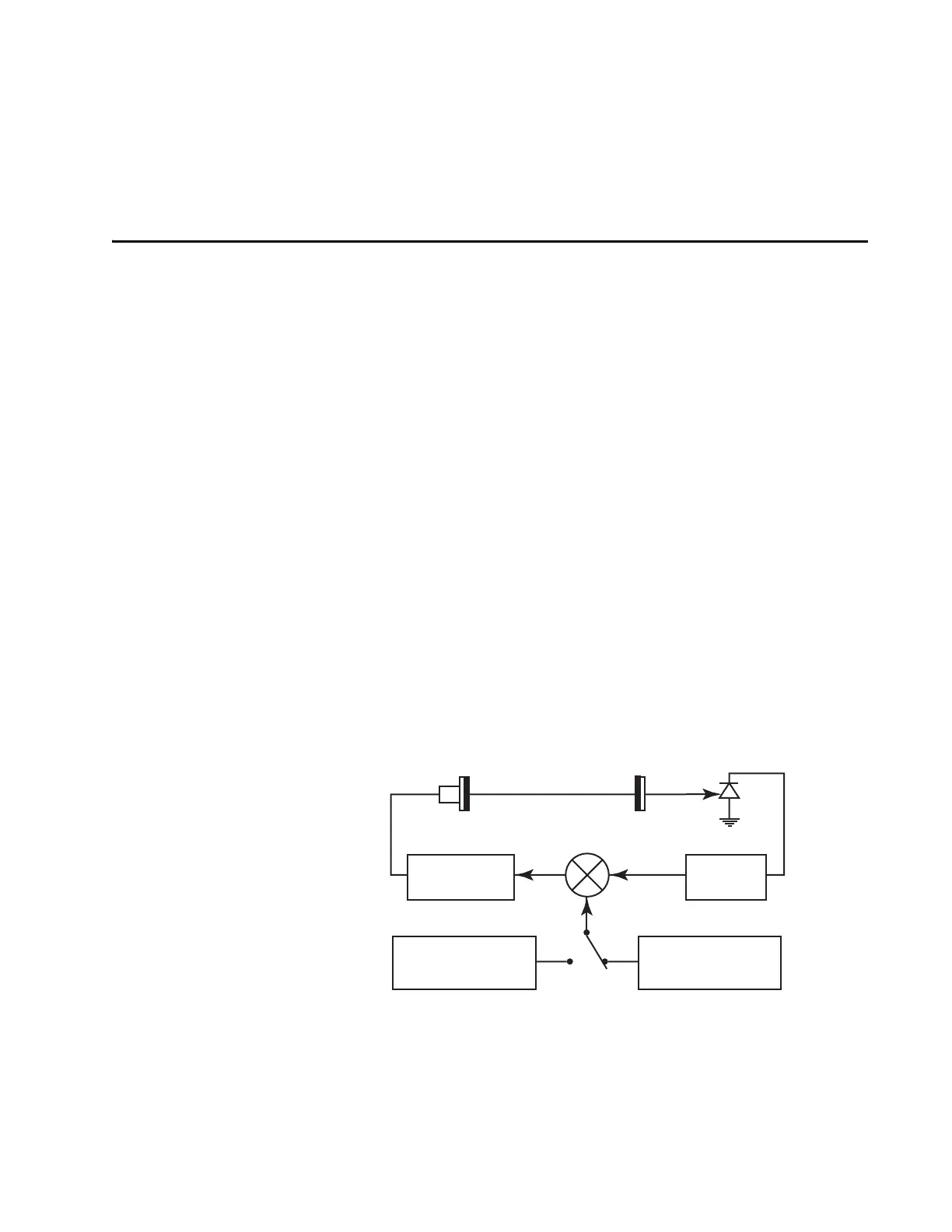
constant. Figure 8-1 illustrates the phase-locked loop (PLL) control circuit.
Figure 8-1: The Lok-to-Clock Phase-locked Loop.
To ensure the Tsunami laser can be tuned over its entire wavelength range
with a fixed repetition rate, it is necessary to have a coarse cavity length
adjustment in addition to the fine length control provided by the
PZT-con
PZT
Laser
Phase
Detector
External Reference
Source
Internal Reference
Source
Servo
Electronics
Filter/
Amplifier


 To Next Page