Tsunami Mode-Locked Ti:sapphire Laser
A-2
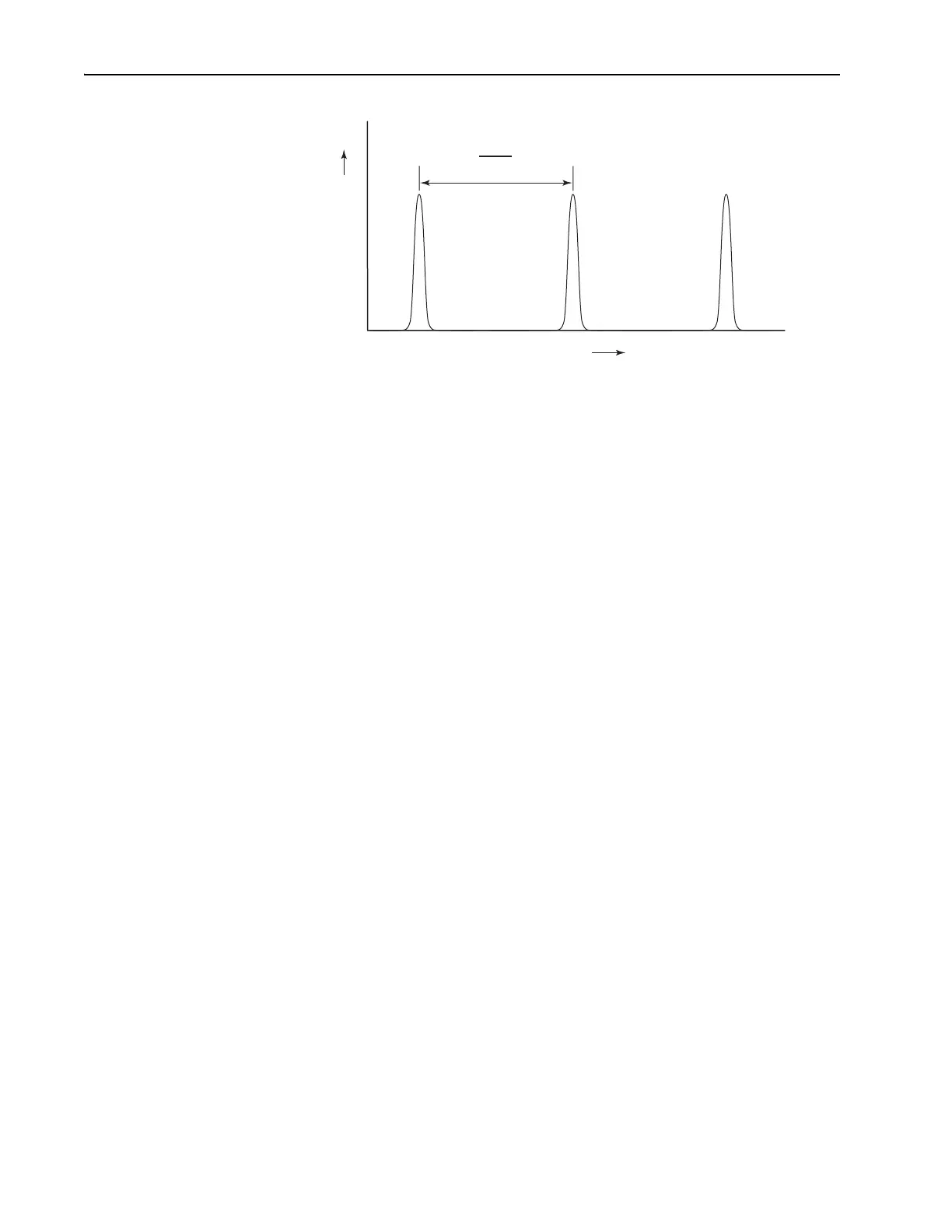
Figure A-1: Typical output of a mode-locked laser, where L is the cav-
ity length and c is the velocity of light.
Modelocking Techniques
A variety of approaches have been used to obtain a train of mode-locked
pulses from different laser systems including active modelocking, passive
modelocking, additive pulse modelocking, and self modelocking.
Active modelocking is by far the most common approach used to obtain
short optical pulses (ps duration) from solid state or gas lasers. A loss mod-
ulation is applied to the laser cavity at the same frequency as the pulse rep-
rate. This is equivalent to introducing an optical shutter into the laser cav-
ity—only light that arrives at the shutter at precisely the correct time passes
through and is amplified in the gain media. Since the shutter is closed at all
other times, a second pulse cannot be formed.
The most common active mode-locking element is an acousto-optic modu-
lator (AOM) which is placed inside the optical cavity close to one of the end
mirrors. The modulator comprises a high quality optical material (such as
quartz) with two highly polished surfaces that are parallel to the direction
of light propagation. Attached to one of these surfaces is a piezoelectric
transducer that is driven at an RF frequency to generate an acoustic wave
within the modulator (Figure A-2). Using the reflection off the opposite
surface, a standing acoustic wave is generated within the modulator. This
induces a time-dependent refractive index grating along an axis perpendic-
ular to the light propagation. As the light interacts with this grating, a por-
tion of it is both diffracted and shifted in frequency by an amount equal to
the acoustic frequency. After passing through the modulator, the diffracted
and undiffracted rays are reflected back through the modulator where a
portion of each beam is diffracted once again.
If the RF drive is at frequency
ω
mL
, the acoustic grating generated by the
standing wave will turn on and off at a rate of 2
ω
mL
. The value for 2
ω
mL
is
chosen to be the same as the laser repetition rate
c
/
2L
. The AOM diffracts
light out of the cavity only when the acoustic grating is present and, thus,
functions as a time-dependent loss. In the frequency domain, this loss
imparts modulation sidebands when a wave passes through the modulator
(Figure A-2). In this manner, the AOM “communicates” the phase between
2L
c
Output Power
Time


 To Next Page