Modelocking
A-3
the longitudinal modes of the laser cavity. The final amplitude and fre-
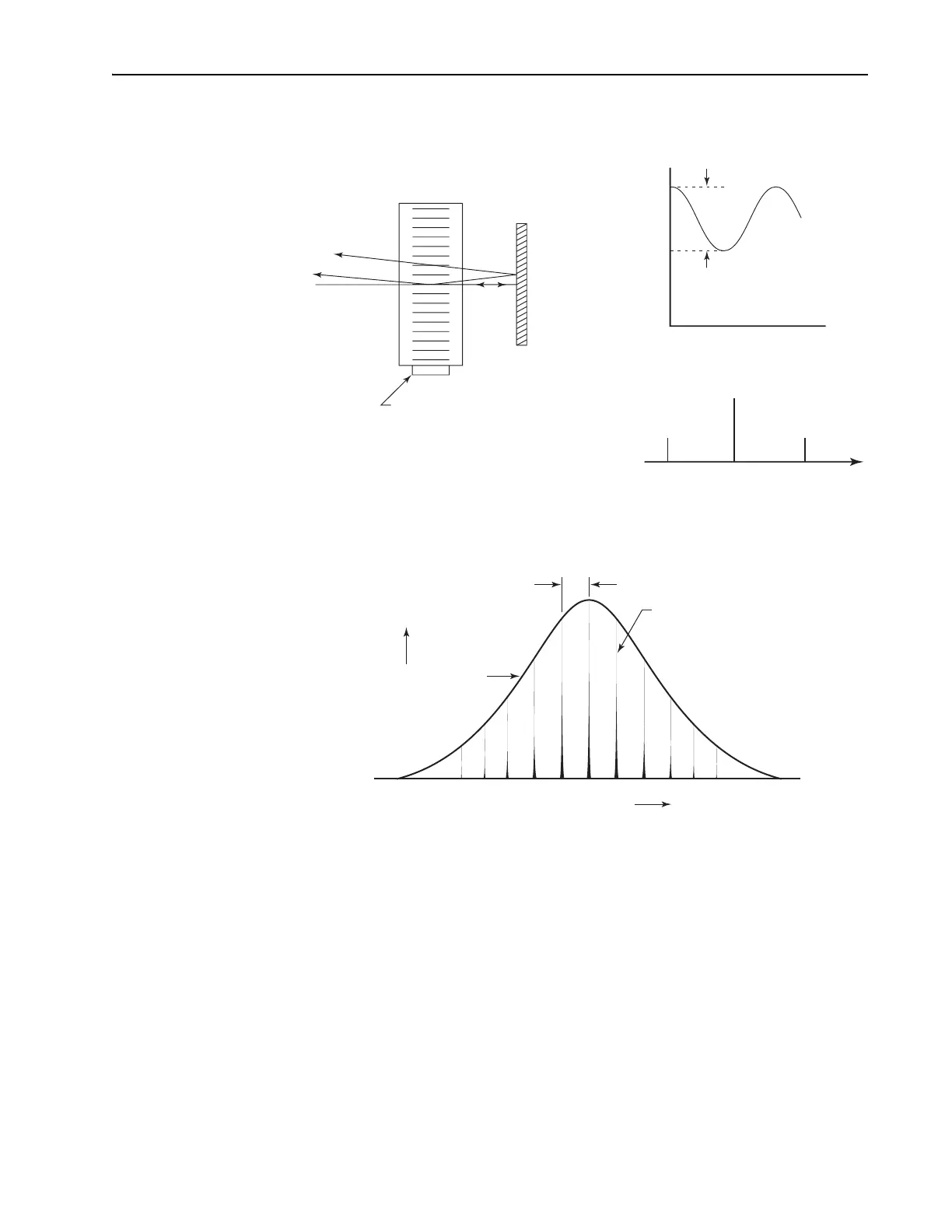
quency of the phase-locked longitudinal modes is shown in Figure A-3.
Figure A-2: Active modelocking using an AOM. Modulation sidebands
are produced when a wave passes through an amplitude modulator.
Figure A-3: Amplitude and frequency of longitudinal modes in a
mode-locked laser.
The modulation frequency 2
ω
mL
must be precisely matched to the repetition
rate of output pulses which is
c
/
2L
. The RF signal used to drive the AOM is,
thus, usually generated by a temperature-stabilized crystal oscillator, and
the cavity length of the laser is adjusted to obtain the appropriate frequency.
The duration of the mode-locked pulses depends on several factors includ-
ing the gain bandwidth of the laser and the modulation depth of the
AOM.
Laser media with greater gain bandwidth have the capability of generating
shorter pulses. Consequently, active modelocking a Nd:YAG laser produces
pulse widths of 30 to 150 ps, while for an ion laser, durations are usually
120 to 200 ps.
Cavity
End
Mirror
ω
mL
Transducer
Acousto-optic Modulator (AOM)
= 2ω
mL
c
/
2L
2∆
m
1−∆
m
∆
m
/2
∆
m
/2
ω ω + ω
mL
ω − ω
mL
Longitudinal
Modes
Gain
Envelope
Frequency (ν)
Gain
Laser Repetition Rate =
c
/
2L
= 2ω
mL
c
/
2L


 To Next Page