Tsunami Mode-Locked Ti:sapphire Laser
2-2
• Establish a controlled access area for laser operation. Limit access to
those trained in the principles of laser safety.
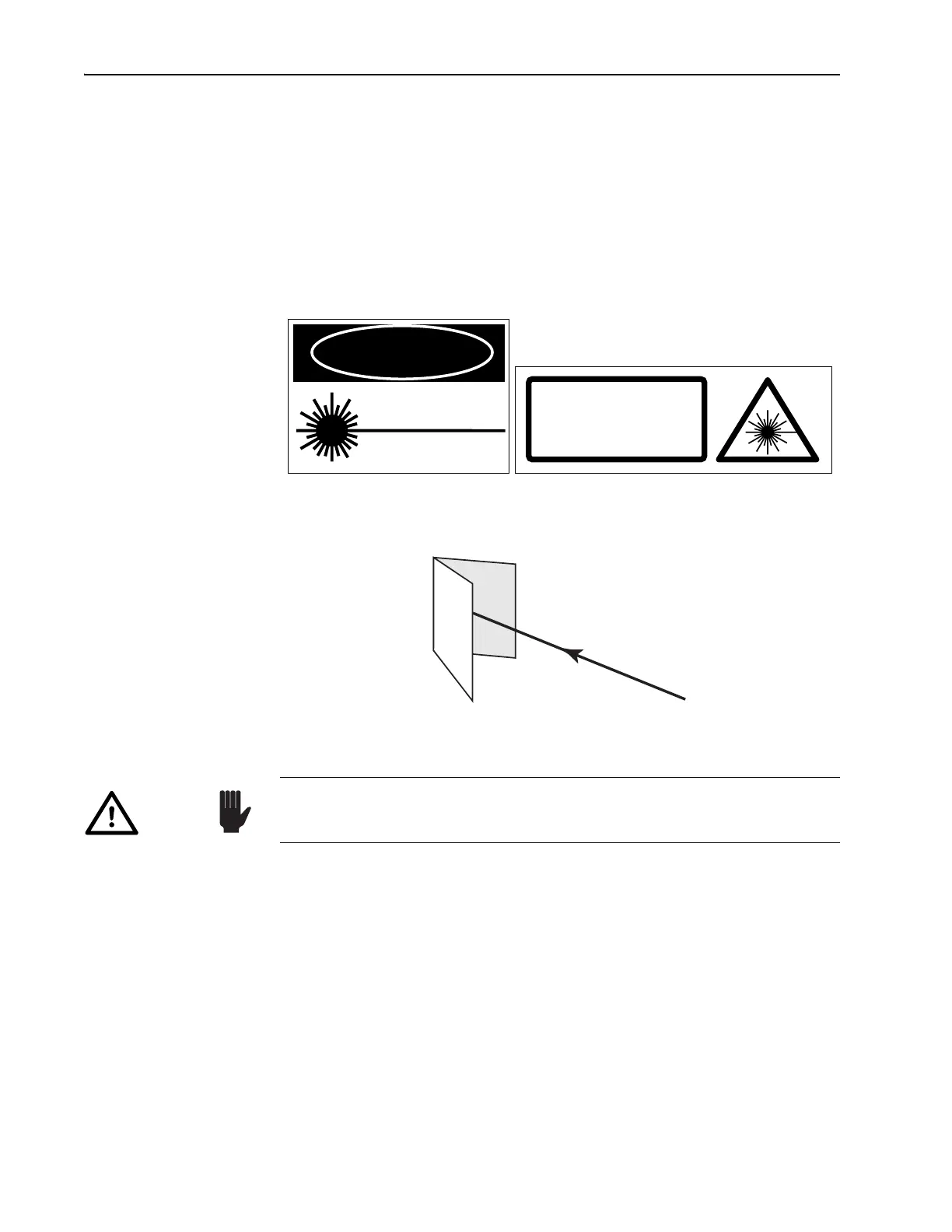
• Post prominent warning signs near the laser operation area (Figure 2-1).
• Set up experiments so the laser beam is either above or below eye
level.
• Provide enclosures for beam paths whenever possible.
• Set up shields to prevent specular reflections.
• Set up an energy absorbing target to capture the laser beam, preventing
unnecessary reflections or scattering (Figure 2-2).
Figure 2-1: These CDRH and CE standard safety warning labels would
be appropriate for use as entry warning signs (ANSI 4.3.10.1, EN 60825-1).
Figure 2-2: Folded Metal Beam Target
Follow the instructions contained in this manual for safe operation of your
laser. At all times during operation, maintenance, or service of your laser,
avoid unnecessary exposure to laser or collateral radiation
*
that exceeds the
accessible emission limits listed in “Performance Standards for Laser Prod-
ucts,” United States Code of Federal Regulations, 21CFR1040 10(d).
*
Any electronic product radiation, except laser radiation, emitted by a laser product as a
result of, or necessary for, the operation of a laser incorporated into that product.
VISIBLE AND/OR INVISIBLE*
LASER RADIATION
AVOID EYE OR SKIN EXPOSURE TO DIRECT OR
SCATTERED RADIATION
CLASS 4 LASER PRODUCT
POWER, WAVELENGTH(S) AND PULSE WIDTH
DEPEND ON PUMP OPTIONS AND LASER
CONFIGURATION.
*SEE MANUAL 0451-8080
DANGER
VISIBLE AND/OR INVISIBLE
LASER RADIATION
AVOID EYE OR SKIN EXPOSURE TO
DIRECT OR SCATTERED RADIATION
POWER, WAVELENGTH AND
PULSE WIDTH DEPEND ON PUMP
OPTIONS AND LASER CONFIGURATION*
CLASS IV LASER PRODUCT
SEE
MANUAL
*
Use of controls or adjustments, or the performance of procedures other
than those specified herein may result in hazardous radiation exposure.
Caution!


 To Next Page