Tsunami Mode-Locked Ti:sapphire Laser
3-2
The separate chiller unit keeps the Tsunami Ti:sapphire rod at a constant
temperature for long-term stable performance. The chiller is fully
described in its own manual shipped with the system.
Ti:sapphire Laser Theory
The Ti
3+
titanium ion is responsible for the laser action of Ti:sapphire.
Ti:sapphire is a crystalline material produced by introducing Ti
2
O
3
into a
melt of Al
2
O
3
. A boule of material is grown from this melt where Ti
3+
ions
are substituted for a small percentage of the Al
3+
ions. The electronic
ground state of the Ti
3+
ion is split into a pair of vibrationally broadened
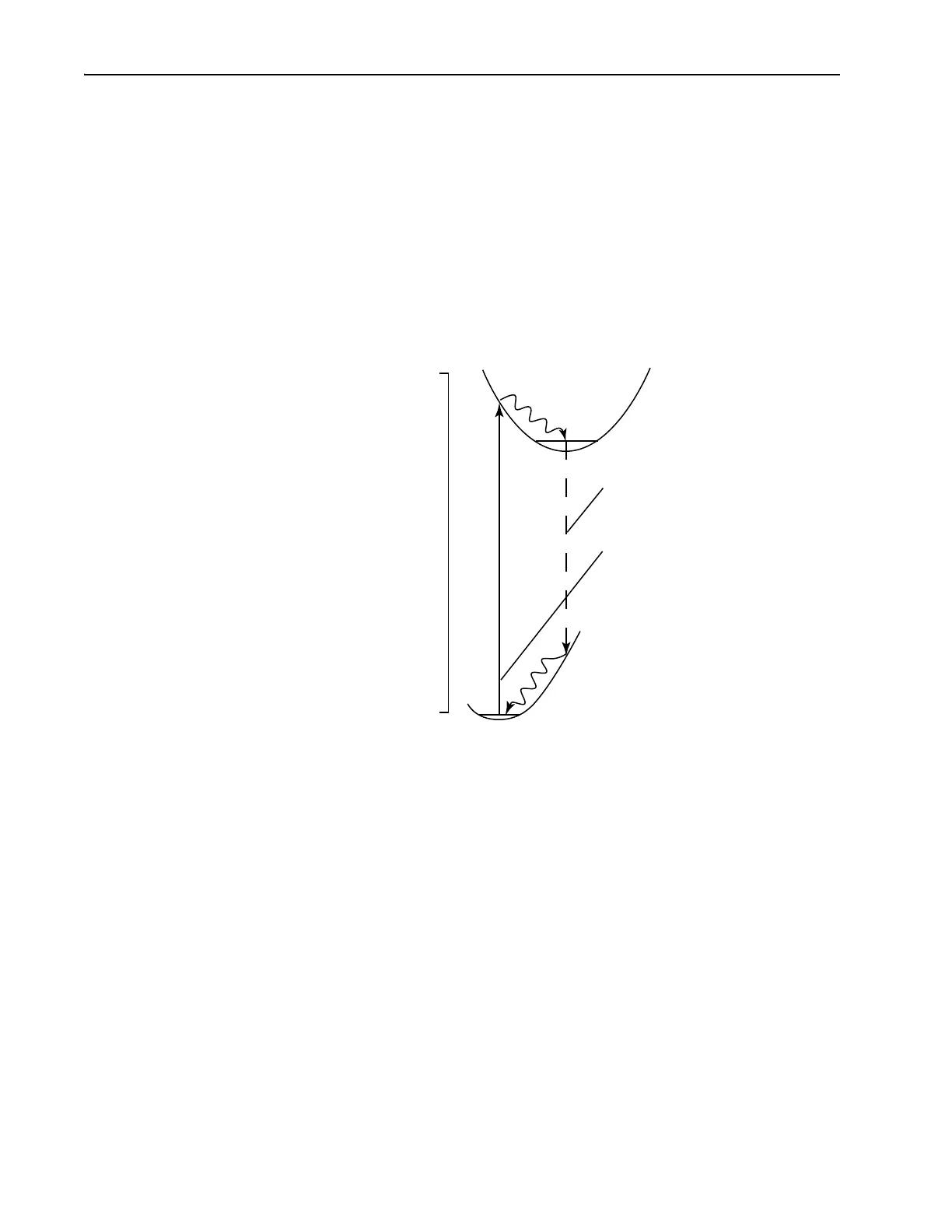
levels as shown in Figure 3-1.
Figure 3-1: Absorption and emission spectra of Ti:sapphire
Absorption transitions occur over a broad range of wavelengths from 400
to 600 nm, only one of which is shown in Figure 3-1. Fluorescence transi-
tions occur from the lower vibrational levels of the excited state to the
upper vibrational levels of the ground state. The resulting emission and
absorption spectra are shown in Figure 3-2.
Although the fluorescence band extends from wavelengths as short as
600 nm to wavelengths greater than 1000 nm, the lasing action is only pos-
sible at wavelengths longer than 670 nm because the long wavelength side
of the absorption band overlaps the short wavelength end of the fluores-
cence spectrum. The tuning range is further reduced by an additional weak
absorption band that overlaps the fluorescence spectrum. This band has
been traced to the presence of Ti
4+
ions, but it is also dependent on material
growth techniques and Ti
3+
concentration. Additionally, the tuning range is
affected by mirror coatings, tuning element losses, pump power, atmo-
spheric absorption (both oxygen and water vapor) and pump mode quality.
Relaxation
Infrared
Fluorescence
Blue-green
Absorption
Energy, 10
3
cm
-1
2
T
2g
2
E
g
20
0


 To Next Page