9-1
Chapter 9 Maintenance
The condition of the laboratory environment and the amount of time you
use the laser affects your periodic maintenance schedule. The coated sur-
faces of the elements forming the laser cavity—the output coupler, GTI or
high reflector, prisms, birefringent filter (ps version), mode locker, fold and
focus mirrors, and rod surfaces—most directly affect the performance of
the laser.
Do not allow smoking in the laboratory. Condensation due to excessive
humidity can also contaminate optical surfaces. The cleaner the environ-
ment, the slower the rate of contamination.
If the laser head cover is left in place, there is little you must do day-to-day
to maintain the laser. To create a dust-free environment, allow purging, and
eliminate time-consuming maintenance, the Tsunami
®
laser head is sealed.
All controls required for day-to-day operation are accessible from the out-
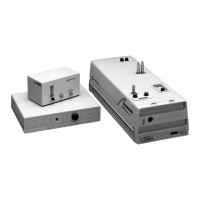
side. The Model 3910 purge regulator/filter is provided as part of the sys-
tem to facilitate cavity purging. The clean, dry, nitrogen gas keeps dust and
moisture out of the laser head. Therefore, the laser head cover should only
be removed when absolutely necessary, e.g., when changing its configura-
tion from ps to fs and vice versa, or when changing optic sets.
Although rarely required, you must change the filters in the Model 3910
purge unit from time to time when the desiccant in the sieve assembly turns
pink. Refer to the Model 3910 section at the end of this chapter.
When you finally do need to clean the optics, follow the procedures below.
Notes on the Cleaning of Laser Optics
Laser optics are made by vacuum-depositing microthin layers of materials
of varying indices of refraction onto glass or quartz substrates. If the sur-
face is scratched to a depth as shallow as 0.01 mm, the operating efficiency
of the optical coating can be reduced significantly and the coating can
degrade.
Lasers are oscillators that operate with gain margins of a few percent.
Losses due to unclean intracavity optics, which might be negligible in ordi-
nary optical systems, can disable a laser. Dust on optical surfaces can cause
loss of output power, damage to the optics or total failure. Cleanliness is
essential, and you must apply laser optics maintenance techniques with
extreme care and with attention to detail.


 To Next Page